The Role of Germline Testing in Cancer Risk Assessment
Introduction
Cancer arises through the accumulation of genetic alterations that disrupt normal cellular regulation. These alterations can occur in two broad categories: somatic mutations and germline mutations. Somatic mutations arise in individual cells during a person’s lifetime and are typically confined to tumor tissue. Germline mutations, in contrast, are inherited genetic variants present in every cell of the body and can be transmitted from parents to offspring.
Understanding the distinction between these two mutation types is central to modern oncology and precision medicine. Somatic testing, which examines mutations present in tumor cells, has become widely used to guide targeted therapies. Germline testing, however, focuses on inherited variants that may increase an individual’s lifetime risk of developing cancer.
Over the past two decades, advances in genomic sequencing technologies have significantly expanded the ability to detect germline mutations associated with hereditary cancer syndromes. These discoveries have enabled clinicians to identify individuals and families with elevated cancer susceptibility and implement strategies for early detection and prevention.
Research across multiple cancer types has demonstrated that inherited variants in specific genes contribute substantially to cancer risk. Identifying these variants allows clinicians to tailor screening programs, implement preventive interventions, and inform family members who may share the same genetic predisposition.
As precision medicine continues to evolve, germline testing is becoming an increasingly important component of comprehensive cancer risk assessment. However, integrating germline testing into routine clinical practice requires careful consideration of ethical, psychological, and healthcare system implications.
Somatic vs. Germline Mutations
The genetic alterations that contribute to cancer can be broadly categorized according to their origin and biological context.
Somatic mutations occur during an individual’s lifetime as a result of DNA replication errors, environmental exposures, or cellular stress. These mutations are confined to specific tissues or tumors and are not inherited by offspring. Somatic mutations are commonly identified through tumor sequencing and often serve as targets for precision oncology therapies.
In contrast, germline mutations are inherited genetic variants present in the reproductive cells of parents and therefore transmitted to their children. These variants are present in every cell of the body and may increase susceptibility to certain cancers.
Individuals who carry pathogenic germline mutations may develop cancer at younger ages or experience multiple primary cancers. In many cases, family members who inherit the same mutation may also face increased cancer risk.
Distinguishing between somatic and germline mutations is essential for clinical decision-making. Somatic testing primarily informs treatment strategies for existing cancers, whereas germline testing focuses on risk assessment, prevention, and family counseling.
Examples of Germline Cancer Predisposition Syndromes
BRCA1 and BRCA2
One of the most well-known examples of hereditary cancer risk involves mutations in the BRCA1 and BRCA2 genes. These genes play critical roles in DNA repair through the homologous recombination pathway, which helps maintain genomic stability.
Pathogenic variants in BRCA1 or BRCA2 impair the cell’s ability to repair DNA damage, leading to increased accumulation of mutations that can promote tumor development.
Individuals who carry BRCA1 or BRCA2 mutations have significantly elevated lifetime risks of several cancers, including:
Breast cancer
Ovarian cancer
Prostate cancer
Pancreatic cancer
Studies have estimated that women with BRCA1 mutations may have a lifetime breast cancer risk exceeding 60%, while BRCA2 mutation carriers also face substantially elevated risk compared with the general population.
Identification of BRCA mutations has important clinical implications. For example, individuals with these mutations may benefit from enhanced surveillance strategies, risk-reducing surgical interventions, or targeted therapies such as PARP inhibitors.
Lynch Syndrome
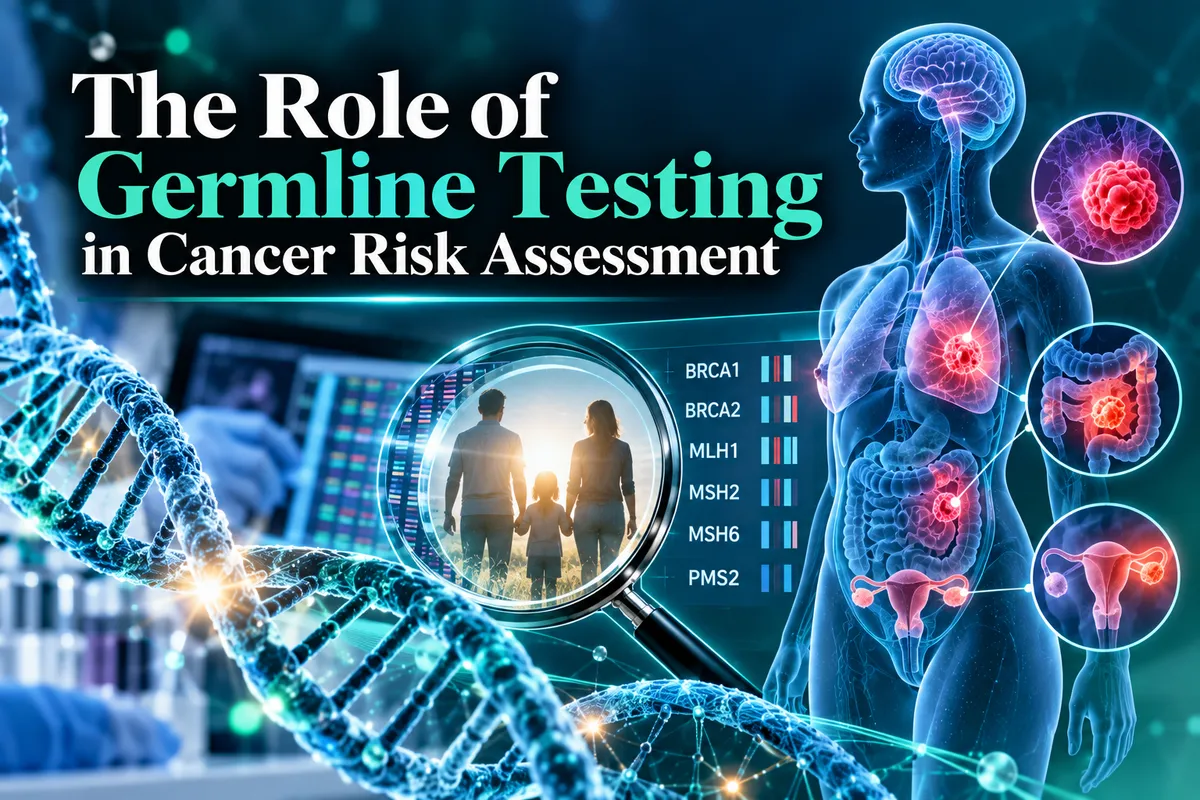
Another well-characterized hereditary cancer syndrome is Lynch syndrome, also known as hereditary nonpolyposis colorectal cancer (HNPCC). Lynch syndrome is caused by germline mutations in genes involved in DNA mismatch repair, including MLH1, MSH2, MSH6, and PMS2.
Defects in mismatch repair lead to the accumulation of DNA replication errors, resulting in a phenomenon known as microsatellite instability (MSI). Tumors associated with Lynch syndrome frequently exhibit high levels of microsatellite instability.
Individuals with Lynch syndrome face increased risks of several cancers, including:
Colorectal cancer
Endometrial cancer
Ovarian cancer
Gastric cancer
Certain urinary tract cancers
Because these cancers often develop earlier than sporadic cases, identifying Lynch syndrome through germline testing allows clinicians to implement early and more frequent screening programs.
Clinical Benefits of Germline Testing
Early Screening and Surveillance
One of the most important benefits of germline testing is the ability to identify individuals who may benefit from earlier and more intensive screening.
For example, individuals with BRCA mutations may begin breast cancer screening at younger ages using imaging modalities such as MRI in addition to mammography. Similarly, individuals with Lynch syndrome may undergo colonoscopic screening at shorter intervals to detect precancerous lesions before malignant transformation occurs.
Early detection of cancer significantly improves treatment outcomes, making surveillance strategies an essential component of hereditary cancer management.
Preventive Interventions
In addition to enhanced screening, germline testing can inform preventive medical interventions aimed at reducing cancer risk.
Preventive strategies may include:
Risk-reducing surgical procedures
Chemoprevention
Lifestyle modifications
Targeted surveillance for multiple cancer types
For example, prophylactic mastectomy or salpingo-oophorectomy may be considered for individuals with high-risk BRCA mutations. Similarly, preventive interventions may be recommended for patients with hereditary gastrointestinal cancer syndromes.
By identifying high-risk individuals before cancer develops, germline testing allows clinicians to shift from reactive treatment toward proactive cancer prevention.
Implications for Family Members
A unique aspect of germline testing is its relevance for biological relatives. Because germline mutations are inherited, identifying a pathogenic variant in one individual may indicate increased risk among family members.
This concept forms the basis of cascade testing, in which relatives of individuals with identified pathogenic mutations are offered genetic testing to determine whether they also carry the variant.
Cascade testing can significantly improve cancer prevention efforts by identifying high-risk individuals within families who may benefit from early surveillance and preventive strategies.
However, communicating genetic risk information within families can be complex and requires careful counseling.
Ethical Considerations
Family Implications
Germline testing raises ethical questions because genetic findings can affect not only the individual tested but also their relatives. Patients must decide whether and how to share genetic information with family members who may also be at risk.
Healthcare providers must balance patient confidentiality with the potential benefits of informing relatives who could benefit from genetic testing or preventive care.
In some cases, patients may choose not to disclose genetic findings to family members, creating ethical challenges for clinicians.
The Role of Genetic Counseling
Because germline testing has far-reaching implications, genetic counseling is an essential component of hereditary cancer risk assessment. Genetic counselors help patients understand the potential outcomes of testing, interpret results, and navigate decisions related to screening and prevention.
Pre-test counseling ensures that patients understand the possible psychological, medical, and familial implications of genetic testing. Post-test counseling helps patients interpret results and develop appropriate management plans.
Genetic counseling also supports informed decision-making and helps patients cope with the emotional impact of learning about inherited cancer risk.
Implementation Challenges
Despite its clinical value, integrating germline testing into routine healthcare systems presents several challenges.
Access to testing remains uneven across healthcare systems and geographic regions. Genetic testing and counseling services may be limited in certain areas, potentially creating disparities in access to precision oncology tools.
Variant interpretation also presents difficulties. Many genetic variants identified through sequencing have uncertain clinical significance, making it challenging to determine their impact on cancer risk.
Additionally, cost considerations and reimbursement policies may influence the availability of germline testing in clinical practice.
Addressing these challenges will require continued investment in genomic infrastructure, education of healthcare providers, and development of standardized clinical guidelines.
Future Directions
Advances in genomic technologies are continuing to expand the scope of germline testing in oncology. Multi-gene panel testing now allows clinicians to examine dozens of cancer susceptibility genes simultaneously, providing more comprehensive risk assessments.
Emerging research is also exploring the role of polygenic risk scores, which aggregate the effects of multiple genetic variants to estimate cancer susceptibility.
In addition, integrating germline genomic data with electronic health records and population health initiatives may enable more systematic identification of individuals at elevated cancer risk.
These developments may ultimately support a more preventive approach to cancer care, in which genetic risk assessment becomes a routine component of clinical practice.
Conclusion
Germline testing has become an increasingly important tool in modern cancer risk assessment. By identifying inherited genetic variants associated with cancer susceptibility, clinicians can implement early screening strategies, preventive interventions, and personalized surveillance programs.
Examples such as BRCA-associated hereditary breast and ovarian cancer and Lynch syndrome illustrate how germline testing can guide clinical management and inform risk assessment for family members.
However, the implementation of germline testing also raises ethical considerations related to family communication, privacy, and genetic counseling. Addressing these issues will be essential for ensuring that genetic information is used responsibly and effectively.
As genomic technologies continue to advance, germline testing will likely play an expanding role in precision oncology and preventive medicine, helping clinicians move from reactive treatment toward proactive risk management.
References
Garber JE, Offit K. Hereditary cancer predisposition syndromes. Journal of Clinical Oncology.
Mersch J, et al. Cancers associated with BRCA1 and BRCA2 mutations. Cancer.
Lynch HT, et al. Hereditary nonpolyposis colorectal cancer (Lynch syndrome). The Lancet.
Mandelker D, et al. Germline testing in precision oncology. JAMA Oncology.
Robson ME, et al. American Society of Clinical Oncology policy statement update: genetic and genomic testing for cancer susceptibility. Journal of Clinical Oncology.