
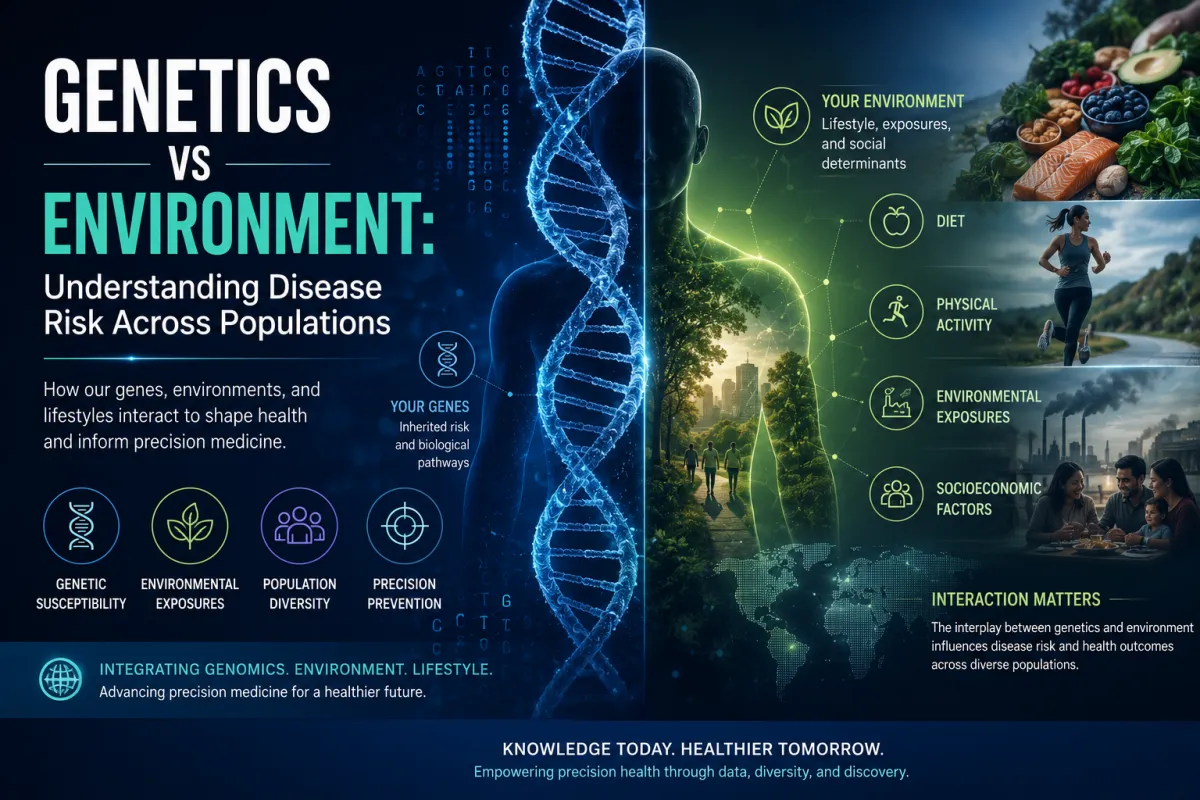
Genetics vs Environment: Understanding Disease Risk Across Populations
Introduction
Human health and disease arise from a complex interplay between genetic predisposition and environmental influences. While some disorders are strongly determined by inherited genetic mutations, most common diseases including cardiovascular disease, diabetes, cancer, and autoimmune conditions result from interactions between genetic susceptibility and external exposures.
Over the past two decades, advances in genomics have substantially improved understanding of the genetic architecture of disease. Genome-wide association studies (GWAS) have identified thousands of genetic variants associated with disease risk. However, genetic variation alone rarely explains the full distribution of disease across populations. Environmental factors including diet, physical activity, socioeconomic conditions, environmental pollutants, and infectious exposures play equally important roles in shaping health outcomes.
The concept of gene environment interaction describes how genetic variants influence an individual's response to environmental exposures. In some cases, environmental factors may activate or suppress genetic pathways involved in disease development. Conversely, genetic variation may modify how individuals respond to lifestyle behaviors, medications, or environmental risks.
Understanding these interactions is central to the goals of precision medicine. By integrating genetic data with environmental and behavioral information, researchers aim to develop more accurate models of disease risk and more targeted strategies for prevention and treatment. Research summarized in Nature Reviews Genetics emphasizes that disentangling genetic and environmental influences is essential for improving disease prediction and translating genomic discoveries into clinical practice.
The Genetic Architecture of Disease
Human genomes differ at millions of positions across the approximately three billion base pairs of DNA. These differences known as genetic variants can influence susceptibility to disease through a variety of mechanisms. Some variants alter protein-coding sequences, while others affect gene regulation, protein expression, or cellular signaling pathways.
In rare cases, single-gene mutations cause inherited diseases such as cystic fibrosis, Huntington’s disease, or certain cardiomyopathies. These disorders follow Mendelian inheritance patterns and typically have a strong genetic basis.
However, most common diseases are polygenic, meaning they are influenced by many genetic variants, each contributing a small increase in risk. For example, genome-wide association studies have identified hundreds of genetic loci associated with conditions such as coronary artery disease, type 2 diabetes, and inflammatory bowel disease.
To quantify the cumulative effect of these variants, researchers have developed polygenic risk scores (PRS), which aggregate the contributions of multiple genetic markers into a single measure of genetic susceptibility. Polygenic risk scores have shown promise in identifying individuals with elevated risk for certain diseases.
Despite these advances, genetic variants alone rarely determine whether an individual will develop a disease. Environmental exposures and lifestyle behaviors often modify genetic risk, illustrating the importance of gene environment interactions.
Environmental Determinants of Health
Environmental factors encompass a wide range of influences on human health. These include:
Lifestyle behaviors such as diet, physical activity, tobacco use, and alcohol consumption
Environmental exposures such as air pollution, toxins, and occupational hazards
Socioeconomic determinants including education, income, and access to healthcare
Early-life exposures, including maternal health and childhood nutrition
These factors contribute significantly to the development of chronic diseases. For example, tobacco exposure remains a major risk factor for lung cancer, while dietary patterns and physical activity influence the risk of metabolic diseases such as obesity and diabetes.
Environmental exposures may also affect biological systems through mechanisms such as epigenetic modification, which alters gene expression without changing the underlying DNA sequence. Epigenetic processes including DNA methylation and histone modification can be influenced by environmental factors and may contribute to disease development.
Understanding how environmental exposures interact with genetic susceptibility is therefore critical for developing effective prevention strategies.
Gene Environment Interactions
Lifestyle Factors
Lifestyle behaviors represent one of the most important domains in which genetic and environmental factors interact. Diet, physical activity, and other lifestyle choices can significantly influence disease risk, particularly in individuals with underlying genetic susceptibility.
For example, individuals carrying certain genetic variants associated with obesity may be more susceptible to weight gain in environments characterized by high caloric intake and sedentary lifestyles. Conversely, adherence to healthy lifestyle behaviors can mitigate genetic risk in many cases.
Research examining cardiovascular disease risk has shown that individuals with high polygenic risk for coronary artery disease can significantly reduce their risk through favorable lifestyle behaviors, including regular physical activity, healthy dietary patterns, and avoidance of smoking.
Similarly, genetic variation may influence how individuals respond to specific dietary components or medications. These interactions form the basis of emerging fields such as nutrigenomics and pharmacogenomics, which seek to tailor dietary recommendations and drug therapies according to genetic profiles.
Environmental Exposures
Environmental exposures including pollutants, toxins, and infectious agents can also interact with genetic susceptibility to influence disease outcomes.
For instance, individuals with certain genetic variants affecting detoxification pathways may be more vulnerable to the harmful effects of environmental toxins. Similarly, genetic differences in immune response genes can influence susceptibility to infectious diseases.
Air pollution provides a well-studied example of gene environment interaction. Exposure to particulate matter has been linked to increased risk of cardiovascular and respiratory disease. However, genetic variation in inflammatory and oxidative stress pathways may modify individual susceptibility to these environmental exposures.
These interactions highlight the importance of considering both genetic and environmental factors when assessing disease risk across populations.
Population-Level Differences in Disease Risk
The distribution of genetic variants varies across human populations due to historical migration patterns, genetic drift, and natural selection. Environmental exposures also differ substantially across geographic regions and socioeconomic contexts.
As a result, disease risk patterns vary between populations. For example:
Certain genetic variants associated with type 2 diabetes occur at different frequencies across populations.
Environmental factors such as diet, urbanization, and physical activity patterns differ across regions.
Access to healthcare and preventive services varies widely across countries and communities.
These differences complicate efforts to develop universal risk prediction models. Many genomic studies have historically focused on populations of European ancestry, which can limit the accuracy of genetic risk models when applied to other populations.
Addressing these disparities requires expanding genomic research to include diverse populations and integrating environmental data into disease prediction frameworks.
Implications for Precision Medicine
Risk Prediction Models
One of the central goals of precision medicine is to improve disease risk prediction by combining genetic information with clinical and environmental data. Traditional risk models often rely on demographic factors and clinical measurements, such as age, blood pressure, or cholesterol levels.
Incorporating genetic information such as polygenic risk scores may enhance these models by identifying individuals with elevated inherited risk. However, genetic risk must be interpreted within the broader context of environmental exposures and lifestyle behaviors.
For example, two individuals with similar genetic risk profiles may experience different health outcomes depending on their diet, physical activity, and exposure to environmental stressors.
Integrating genetic and environmental data into comprehensive predictive models represents an important area of ongoing research.
Clinical Decision-Making
Gene environment interactions also have implications for clinical decision-making. Understanding how environmental exposures influence genetic pathways may inform personalized prevention strategies and therapeutic interventions.
Examples include:
Tailoring lifestyle interventions according to genetic susceptibility
Identifying environmental risk factors that disproportionately affect genetically susceptible individuals
Developing targeted therapies based on molecular disease mechanisms
However, translating gene environment research into clinical practice remains challenging. Many interactions are complex and require large datasets to detect reliably.
Implementation Challenges
Several challenges must be addressed to fully integrate gene environment insights into precision medicine.
Data integration represents a major obstacle. Genetic data are increasingly available through genomic sequencing and biobank initiatives, but detailed environmental exposure data are often more difficult to capture systematically.
Measurement of environmental exposures can be particularly challenging. Environmental influences may vary across time and geographic location, making accurate assessment difficult.
Population diversity also presents challenges. Risk models developed in one population may not perform equally well in others due to differences in genetic variation and environmental exposures.
Finally, ethical and social considerations must be addressed when integrating genetic data into healthcare systems. Ensuring privacy, preventing discrimination, and maintaining equitable access to precision medicine tools are essential priorities.
Future Research Directions
Advancing the study of gene environment interactions will require interdisciplinary collaboration across genetics, epidemiology, environmental science, and data science.
Several emerging research approaches may accelerate progress in this area:
Large-scale biobank studies that link genomic data with environmental and lifestyle information
Integration of wearable device data to measure behavioral and environmental exposures
Use of artificial intelligence and machine learning to analyze complex datasets
Development of exposome frameworks that capture cumulative environmental exposures across the lifespan
These approaches may enable more comprehensive models of disease risk that reflect the full complexity of human health.
Conclusion
The development of most common diseases reflects a complex interplay between genetic susceptibility and environmental influences. While advances in genomics have expanded understanding of the genetic architecture of disease, environmental exposures and lifestyle factors remain major determinants of health outcomes.
Gene environment interactions provide a framework for understanding how these influences combine to shape disease risk across populations. Integrating genetic data with environmental and behavioral information represents a central goal of precision medicine.
For clinicians, researchers, and healthcare leaders, appreciating the dynamic relationship between genetics and environment is essential for developing effective prevention strategies and improving disease prediction models. Continued research and expanded data integration will be critical for translating gene environment insights into clinical practice and population health initiatives.
References
Hunter DJ. Gene-environment interactions in human diseases. Nature Reviews Genetics. https://www.nature.com/articles/s41576-018-0005-y
Manolio TA, et al. Finding the missing heritability of complex diseases. Nature.
Khera AV, et al. Genome-wide polygenic scores for common diseases identify individuals with risk equivalent to monogenic mutations. Nature Medicine.
Khoury MJ, et al. Precision medicine and the future of public health. JAMA.
Patel CJ, et al. The exposome and environmental determinants of disease. Science.