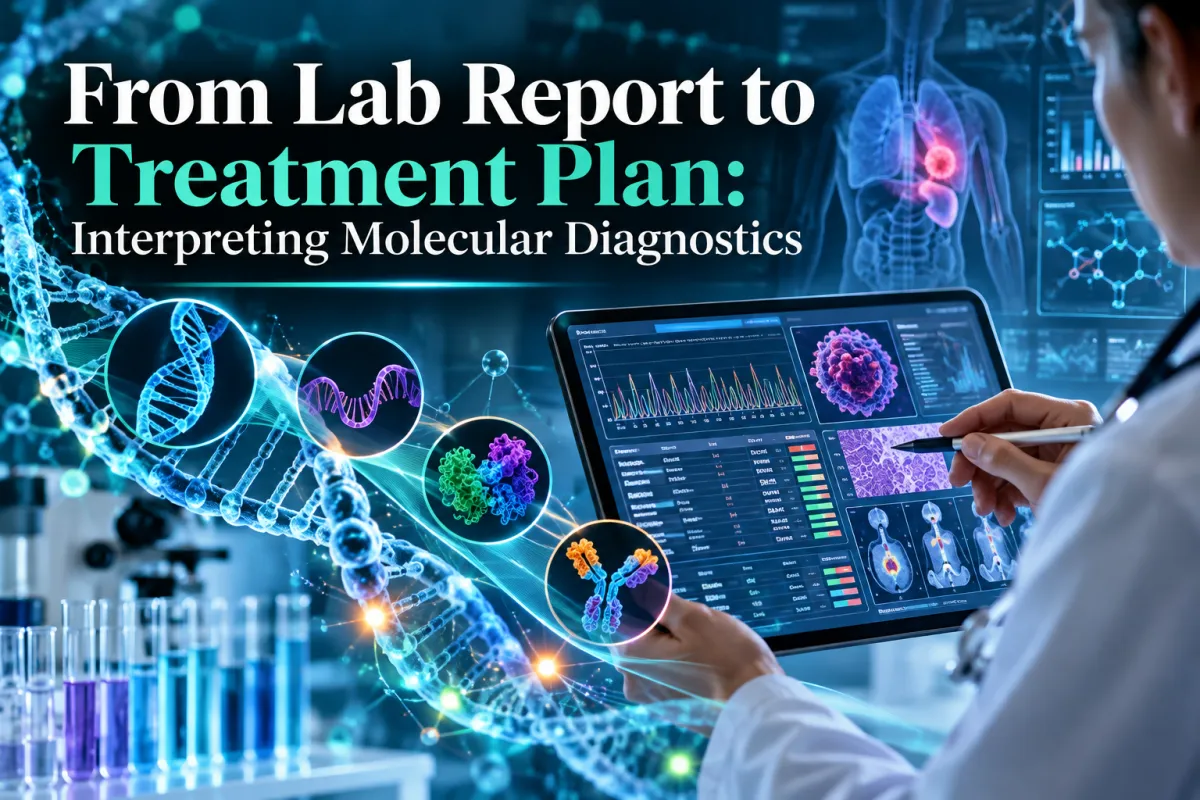
From Lab Report to Treatment Plan: Interpreting Molecular Diagnostics
Introduction
Advances in molecular biology and genomic technologies have transformed modern clinical diagnostics. Over the past two decades, the availability of molecular testing has expanded rapidly, enabling clinicians to examine disease processes at the level of genes, RNA transcripts, and proteins. These technologies have become central to precision medicine, which seeks to tailor treatment strategies to the molecular characteristics of individual patients.
Molecular diagnostics now play a critical role in multiple areas of medicine, including oncology, infectious disease, inherited disorders, and pharmacogenomics. For example, genomic sequencing can identify mutations associated with cancer, transcriptomic profiling can reveal disease-specific gene expression patterns, and proteomic analysis can detect abnormal protein signaling pathways.
However, as molecular testing becomes more widely used, clinicians face increasing challenges in interpreting complex laboratory reports and translating molecular findings into actionable clinical decisions. Molecular diagnostic reports may contain extensive genomic information, including variants of uncertain significance, complex bioinformatic annotations, and references to emerging therapeutic targets.
Understanding how to interpret these reports is therefore essential for clinicians working in precision medicine. Research published in Diagnostics and other peer-reviewed journals emphasizes that molecular diagnostics are now central to guiding targeted therapies, risk stratification, and treatment selection across multiple medical disciplines.
This article explores the major types of molecular tests used in modern medicine, explains how molecular diagnostic reports are structured, and examines how clinicians translate laboratory findings into patient-centered treatment strategies.
The Expansion of Molecular Testing
The rapid growth of molecular diagnostics has been driven by several technological developments. High-throughput sequencing platforms, advanced mass spectrometry methods, and improved computational tools have dramatically expanded the ability to analyze biological molecules at scale.
These technologies allow clinicians and researchers to examine disease at multiple biological levels:
DNA, which contains inherited genetic information
RNA, which reflects gene expression patterns
Proteins, which carry out cellular functions and signaling
Analyzing these molecular layers can reveal disease mechanisms that may not be visible through traditional diagnostic approaches such as histopathology or imaging.
For example, tumors that appear similar under microscopic examination may have distinct genetic mutations that influence treatment response. Molecular testing therefore enables clinicians to classify diseases according to their biological drivers rather than solely by anatomical location or histological appearance.
As a result, molecular diagnostics are increasingly incorporated into clinical guidelines for cancer treatment, rare disease diagnosis, and pharmacogenomic testing.
Types of Molecular Tests
Genomic Sequencing
Genomic sequencing is one of the most widely used molecular diagnostic tools. These tests analyze DNA sequences to identify genetic variants that may influence disease risk, diagnosis, or treatment response.
Several types of genomic sequencing are commonly used in clinical practice:
Targeted gene panels, which analyze specific genes associated with a disease
Whole-exome sequencing, which examines the protein-coding regions of the genome
Whole-genome sequencing, which analyzes the entire DNA sequence
In oncology, genomic sequencing can identify mutations that drive tumor growth and may be targeted by specific therapies. For example, mutations in genes such as EGFR, BRAF, or ALK can guide the use of targeted therapies in certain cancers.
In rare disease diagnostics, genomic sequencing can identify previously unknown genetic mutations responsible for inherited disorders.
Transcriptomics
Transcriptomic testing examines RNA molecules produced during gene expression. Because RNA reflects which genes are actively being expressed in a cell or tissue, transcriptomic analysis provides insight into cellular activity and disease processes.
Techniques used in transcriptomics include RNA sequencing (RNA-seq) and gene expression microarrays. These methods can reveal patterns of gene expression associated with specific disease states.
In oncology, transcriptomic profiling may help classify tumors into molecular subtypes and identify pathways involved in tumor progression. Gene expression signatures have also been used to predict prognosis and treatment response in certain cancers.
Beyond oncology, transcriptomic analysis is increasingly being explored in autoimmune diseases, neurological disorders, and infectious diseases.
Proteomics
Proteomics involves the large-scale analysis of proteins within biological samples. Because proteins carry out most cellular functions, proteomic analysis provides direct insight into disease-related biological processes.
Proteomic testing often relies on mass spectrometry and antibody-based detection technologies to measure protein abundance and interactions.
In clinical settings, proteomic biomarkers can assist in disease diagnosis, monitoring disease progression, or predicting therapeutic response. For example, certain protein biomarkers are used in cardiovascular disease risk assessment and cancer monitoring.
Integrating proteomic data with genomic and transcriptomic information may provide a more comprehensive understanding of disease mechanisms.
Key Components of a Molecular Diagnostic Report
Interpreting molecular diagnostic results requires understanding several key elements commonly included in laboratory reports.
Variant Classification
One of the central components of genomic test reports is variant classification. Genetic variants identified through sequencing are typically categorized according to their potential impact on disease.
The American College of Medical Genetics and Genomics (ACMG) has established widely used guidelines for classifying genetic variants into several categories:
Pathogenic
Likely pathogenic
Variant of uncertain significance (VUS)
Likely benign
Benign
Pathogenic variants have strong evidence supporting their role in disease, whereas variants of uncertain significance require additional research or clinical correlation.
Clinicians must carefully interpret variant classifications and consider the patient’s clinical presentation, family history, and other diagnostic findings.
Clinical Significance
In addition to variant classification, molecular reports often include information about the clinical significance of identified mutations. This section may describe how specific genetic variants are associated with disease risk, prognosis, or treatment response.
For example, certain mutations may indicate a higher likelihood of disease progression or resistance to particular therapies. In other cases, variants may suggest susceptibility to specific medications or adverse drug reactions.
Laboratories often reference scientific literature and clinical guidelines when interpreting the clinical relevance of genetic findings.
Actionable Mutations
Another key element in many molecular reports is the identification of actionable mutations. These are genetic alterations that have known therapeutic implications.
Actionable mutations may indicate:
Eligibility for targeted therapies
Sensitivity to specific medications
Potential benefit from clinical trial participation
In oncology, actionable mutations have become central to precision treatment strategies. Molecular testing may identify tumor mutations that can be targeted with specific drugs designed to inhibit abnormal signaling pathways.
However, not all identified variants are clinically actionable, and interpreting their significance requires careful evaluation of available evidence.
Clinical Decision Making
Treatment Implications
Once molecular findings are interpreted, clinicians must determine how the results influence treatment strategies. In some cases, molecular testing directly guides therapy selection.
For example, identifying specific genetic mutations in tumors may support the use of targeted therapies designed to inhibit mutated signaling pathways. Similarly, pharmacogenomic testing may inform medication selection or dosage adjustments.
However, the presence of a genetic variant does not automatically determine treatment decisions. Clinicians must consider additional factors such as disease stage, patient comorbidities, prior treatments, and overall clinical context.
In many cases, molecular findings serve as one component of a broader clinical decision-making process.
Follow-Up Testing
Molecular diagnostic reports may also suggest the need for additional testing. For example, identifying a genetic mutation associated with hereditary disease may prompt testing of family members.
In oncology, follow-up molecular testing may be performed to monitor treatment response or detect emerging resistance mutations.
As molecular technologies continue to evolve, serial molecular testing may become increasingly common in clinical practice, enabling dynamic monitoring of disease progression.
The Importance of Multidisciplinary Teams
Because molecular diagnostics generate complex datasets, interpreting these findings often requires collaboration among multiple healthcare professionals.
Multidisciplinary molecular tumor boards are increasingly used in oncology to review genomic test results and discuss treatment strategies. These teams typically include oncologists, pathologists, molecular biologists, genetic counselors, bioinformaticians, and pharmacists.
Such collaborative models help ensure that molecular findings are interpreted accurately and integrated into clinical care effectively.
In addition to oncology, interdisciplinary collaboration is important in fields such as rare disease diagnostics, transplant medicine, and pharmacogenomics.
Implementation Challenges
Despite the growing importance of molecular diagnostics, several challenges remain.
Data complexity is a major issue. Genomic sequencing can generate large numbers of variants, many of which have uncertain clinical significance. Interpreting these findings requires specialized knowledge and access to up-to-date scientific databases.
Clinical education is another challenge. Many clinicians have limited formal training in genomics and molecular diagnostics. Expanding educational programs and decision support tools may help address this gap.
Healthcare infrastructure also plays a role. Integrating molecular data into electronic health records and clinical workflows requires advanced digital systems and standardized reporting formats.
Addressing these challenges will be essential for ensuring that molecular diagnostics can be effectively integrated into routine clinical care.
Future Directions
The field of molecular diagnostics continues to evolve rapidly. Advances in sequencing technologies, artificial intelligence, and multi-omics analysis are expanding the range of information available to clinicians.
Future developments may include:
Integration of genomic, transcriptomic, and proteomic data into unified diagnostic frameworks
AI-assisted interpretation of complex molecular datasets
Expanded use of molecular diagnostics in early disease detection and preventive medicine
Greater integration of genomic data into routine clinical decision support systems
These developments may help bridge the gap between laboratory findings and clinical treatment planning.
Conclusion
Molecular diagnostics have become a cornerstone of modern precision medicine. By analyzing genetic variants, gene expression patterns, and protein biomarkers, these technologies provide detailed insights into the biological mechanisms underlying disease.
However, translating molecular findings into clinical treatment decisions requires careful interpretation, interdisciplinary collaboration, and integration with broader clinical information.
Understanding the structure and implications of molecular diagnostic reports is increasingly important for clinicians across multiple specialties. As molecular testing continues to expand, healthcare systems must develop the expertise, infrastructure, and collaborative models necessary to ensure that these powerful diagnostic tools improve patient outcomes.
References
Jennings LJ, Arcila ME, Corless C, et al. Guidelines for validation of next-generation sequencing-based oncology panels. Diagnostics. https://www.ncbi.nlm.nih.gov/pmc/articles/PMC7048937/
Ashley EA. The precision medicine initiative: a new national effort. New England Journal of Medicine.
Garraway LA, Verweij J, Ballman KV. Precision oncology: an overview. Journal of Clinical Oncology.
Torkamani A, Wineinger NE, Topol EJ. The personal and clinical utility of polygenic risk scores. Nature Reviews Genetics.
Collins FS, Varmus H. A new initiative on precision medicine. New England Journal of Medicine.