CRISPR and Gene Editing: Transforming the Future of Disease Treatment
Introduction
Advances in molecular biology over the past several decades have fundamentally reshaped the understanding of human disease. Many disorders particularly inherited genetic conditions arise from specific mutations that alter the function of proteins or regulatory elements within the genome. Traditional medical treatments have typically focused on managing symptoms or modifying downstream biological pathways rather than correcting the underlying genetic defect.
Gene editing technologies have introduced the possibility of directly modifying DNA sequences within living cells. Among these technologies, the Clustered Regularly Interspaced Short Palindromic Repeats (CRISPR) system has emerged as one of the most influential tools in modern biomedical research. CRISPR-based methods allow scientists to precisely target and modify genetic sequences, raising the prospect of correcting disease-causing mutations at their source.
Originally identified as part of a bacterial adaptive immune system, CRISPR was adapted for genome editing in mammalian cells in the early 2010s. Since then, it has rapidly expanded into a versatile platform for genetic research, therapeutic development, and biotechnology applications. According to foundational research published in Nature, CRISPR-based genome editing enables targeted modification of DNA sequences with unprecedented precision and efficiency.
For clinicians and researchers engaged in precision medicine, gene editing technologies represent a potentially transformative approach to disease treatment. By enabling direct manipulation of the genome, CRISPR offers new possibilities for addressing inherited disorders, improving cancer therapies, and advancing regenerative medicine. However, these developments also raise complex scientific, ethical, and regulatory questions that must be carefully addressed as gene editing technologies move toward clinical implementation.
The Emergence of Gene Editing Technologies
Gene editing did not begin with CRISPR. Earlier technologies including zinc finger nucleases (ZFNs) and transcription activator-like effector nucleases (TALENs) provided initial methods for targeted DNA modification. These systems rely on engineered proteins that recognize specific DNA sequences and introduce double-strand breaks in the genome.
Although effective, these earlier approaches were technically complex and difficult to scale. Designing new protein-based nucleases for each genomic target required extensive molecular engineering, limiting their widespread use.
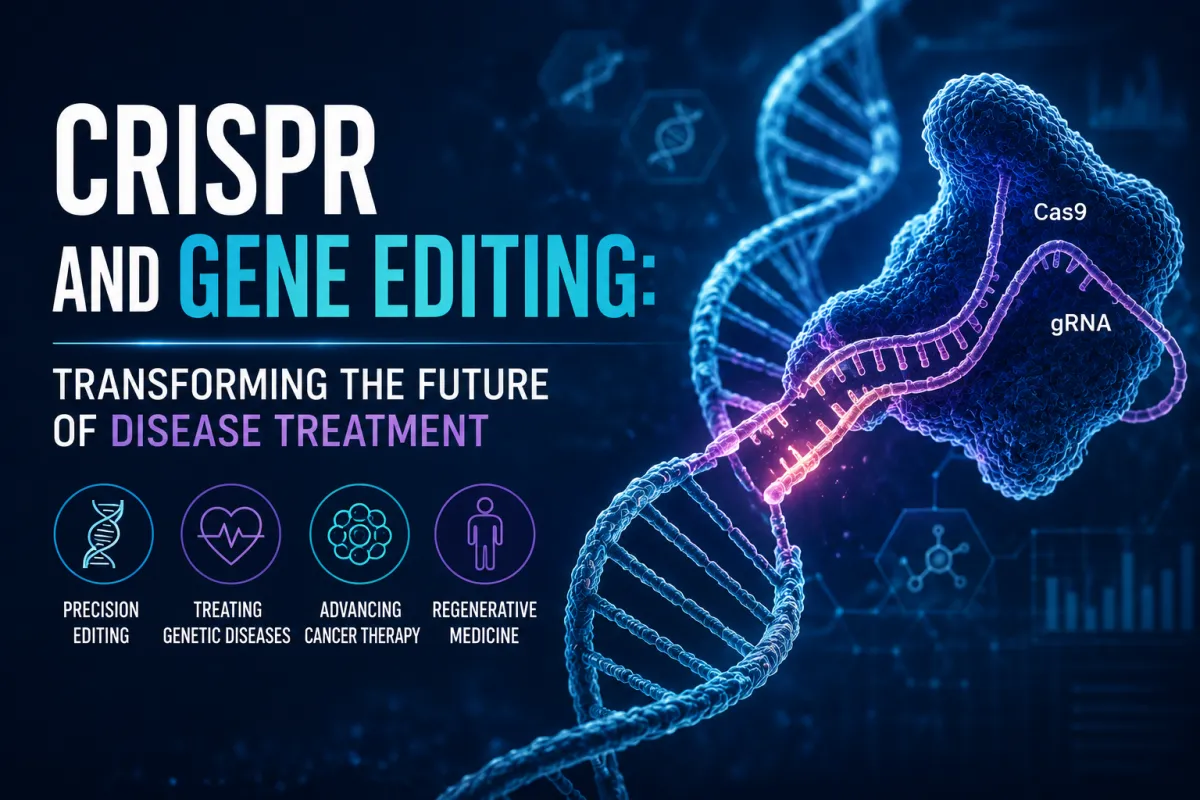
The discovery and adaptation of CRISPR systems significantly simplified the gene editing process. CRISPR uses RNA molecules to guide an endonuclease enzyme to specific DNA sequences. Because RNA sequences can be easily designed and synthesized, CRISPR allows researchers to rapidly target different genomic regions without complex protein engineering.
Since its introduction into mammalian genome editing in 2012, CRISPR has become widely used in biomedical research laboratories and has entered early clinical trials for several diseases. The technology has also stimulated the development of additional genome editing platforms, including base editing and prime editing, which further expand the range of possible genetic modifications.
How CRISPR Works
The CRISPR system most commonly used for genome editing involves two primary components:
Guide RNA (gRNA)
CRISPR-associated protein 9 (Cas9)
The guide RNA is designed to match a specific DNA sequence within the genome. Once introduced into a cell, the guide RNA directs the Cas9 enzyme to the target location through complementary base pairing.
When the Cas9 enzyme reaches the target site, it creates a double-strand break in the DNA. This break activates the cell’s natural DNA repair mechanisms, which can be harnessed to introduce specific genetic changes.
Two primary DNA repair pathways are involved:
Non-homologous end joining (NHEJ): This repair process often introduces small insertions or deletions, which can disrupt gene function.
Homology-directed repair (HDR): This pathway can incorporate a new DNA template provided by researchers, allowing precise correction of genetic mutations.
Through these mechanisms, CRISPR enables several types of genetic modifications:
Disabling disease-causing genes
Correcting pathogenic mutations
Introducing new genetic sequences
Modulating gene expression
More recent innovations have expanded the CRISPR toolkit. Base editing allows researchers to modify individual nucleotides without creating double-strand breaks, while prime editing enables more complex DNA modifications with potentially fewer unintended effects.
These advancements continue to improve the precision and versatility of gene editing technologies.
Applications in Disease Treatment
Genetic Diseases
One of the most promising applications of CRISPR involves the treatment of monogenic genetic disorders, which are caused by mutations in a single gene. Because the underlying genetic defect is well defined, gene editing offers a potential strategy for correcting the mutation directly.
Several genetic diseases have become early targets for CRISPR-based therapies, including:
Sickle cell disease
Beta-thalassemia
Inherited retinal disorders
Certain metabolic diseases
Clinical trials involving CRISPR-based treatments for sickle cell disease and beta-thalassemia have demonstrated encouraging results. These therapies often involve editing hematopoietic stem cells outside the body (ex vivo) and then reinfusing the modified cells into the patient.
In these trials, gene editing has been used to reactivate fetal hemoglobin production, compensating for defective adult hemoglobin and reducing disease symptoms. Although long-term outcomes remain under investigation, early results suggest that gene editing may offer durable therapeutic benefits for some patients with inherited blood disorders.
Oncology
Gene editing technologies are also being explored in oncology. Cancer is fundamentally a genetic disease characterized by mutations that disrupt normal cellular regulation. CRISPR has been widely used in research settings to study cancer genetics and identify potential therapeutic targets.
One clinical application involves the modification of immune cells used in adoptive cell therapy, such as chimeric antigen receptor (CAR) T cells. Gene editing can enhance the ability of these engineered immune cells to recognize and attack tumor cells.
For example, CRISPR-based editing has been used experimentally to disable genes that suppress immune cell activity, potentially improving the effectiveness of immunotherapies. Researchers are also investigating methods for editing tumor cells directly or modifying immune regulatory pathways to enhance antitumor responses.
Although these applications remain largely experimental, gene editing may eventually complement existing immunotherapy strategies in precision oncology.
Regenerative Medicine
CRISPR technology is also being investigated in the context of regenerative medicine. Tissue damage resulting from degenerative diseases, injury, or aging represents a major clinical challenge.
By combining gene editing with stem cell technologies, researchers hope to develop therapies capable of repairing or replacing damaged tissues. For example, CRISPR has been used experimentally to correct genetic mutations in induced pluripotent stem cells derived from patients with inherited diseases.
These corrected cells can potentially be differentiated into healthy tissue types for transplantation. Applications under investigation include therapies for retinal degeneration, muscular dystrophy, and neurodegenerative diseases.
Although these approaches remain in early stages of development, they illustrate the potential of gene editing to support regenerative therapies.
Risks and Ethical Considerations
Despite its promise, CRISPR-based gene editing raises several important scientific and ethical concerns.
One key issue involves off-target effects, in which the CRISPR system introduces unintended genetic changes at sites other than the intended target. Although advances in guide RNA design and enzyme engineering have reduced the frequency of off-target editing, ensuring genomic safety remains a priority for clinical applications.
Another challenge involves delivery mechanisms. Efficiently delivering CRISPR components into specific tissues within the human body remains technically complex. Viral vectors, lipid nanoparticles, and other delivery systems are being explored to address this challenge.
Ethical considerations also play a critical role in gene editing discussions. While somatic gene editing modifying cells within an individual patient raises fewer ethical concerns, germline editing, which alters genetic material in reproductive cells or embryos, has far-reaching implications. Germline modifications could be inherited by future generations, raising concerns about unintended consequences and ethical governance.
International scientific organizations and regulatory agencies have emphasized the need for careful oversight and ethical frameworks governing gene editing research. Public engagement and transparent policy development will be essential as the technology continues to evolve.
Future Outlook
The rapid development of CRISPR and related gene editing technologies has created new opportunities for understanding and treating human disease. Several areas of research are likely to shape the future of the field.
First, continued improvements in editing precision and efficiency may reduce unintended effects and expand the range of diseases that can be targeted. Technologies such as base editing and prime editing already demonstrate increased control over genetic modifications.
Second, advances in delivery systems may enable more effective in vivo editing approaches, allowing gene editing components to be delivered directly to affected tissues.
Third, integration of gene editing with other emerging technologies including genomics, artificial intelligence, and systems biology may improve target identification and therapeutic design.
Finally, as gene editing therapies move through clinical trials, ongoing evaluation of long-term safety and efficacy will be essential. Regulatory agencies and healthcare systems will need to develop frameworks for evaluating and implementing these therapies responsibly.
Conclusion
CRISPR-based gene editing represents one of the most significant advances in modern biomedical science. By enabling precise modification of DNA sequences, CRISPR has opened new possibilities for addressing the genetic foundations of human disease.
Applications in genetic disorders, oncology, and regenerative medicine highlight the broad potential of gene editing technologies within precision medicine. At the same time, challenges related to safety, delivery, ethical governance, and regulatory oversight must be addressed as these therapies move toward clinical practice.
For clinicians, researchers, and healthcare leaders, understanding the evolving landscape of gene editing will be increasingly important. Continued interdisciplinary collaboration will be essential to ensure that gene editing technologies are developed and applied in ways that improve patient outcomes while maintaining rigorous ethical and scientific standards.
References
Komor AC, Badran AH, Liu DR. CRISPR-based technologies for the manipulation of eukaryotic genomes. Nature. https://www.nature.com/articles/nature24287
Doudna JA, Charpentier E. The new frontier of genome engineering with CRISPR-Cas9. Science.
Cox DBT, Platt RJ, Zhang F. Therapeutic genome editing: prospects and challenges. Nature Medicine.
Porteus MH. A new class of medicines through DNA editing. New England Journal of Medicine.
Hsu PD, Lander ES, Zhang F. Development and applications of CRISPR-Cas9 for genome engineering. Cell.