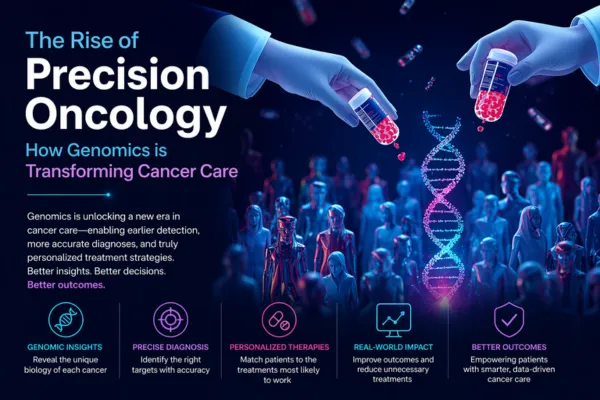
The Rise of Precision Oncology: How Genomics Is Transforming Cancer Care
Introduction
Cancer has long been recognized as a biologically heterogeneous disease, yet historically it has often been treated using relatively uniform therapeutic approaches. For decades, cancer management relied on the “one-size-fits-all” paradigm, in which patients with similar tumor types defined primarily by anatomical location and histology received broadly similar treatments. Chemotherapy, radiation therapy, and surgery formed the foundation of cancer treatment, with clinical decisions guided largely by tumor stage, histopathologic classification, and clinical performance status.
Although these approaches improved survival for many patients, they did not fully account for the underlying molecular diversity of tumors. Clinicians frequently observed that patients with seemingly similar cancers responded very differently to the same therapy. Some experienced dramatic responses, while others derived minimal benefit or developed resistance. These observations underscored an emerging understanding: cancers that appear similar under the microscope may differ profoundly at the genomic level.
Precision oncology has emerged in response to this recognition. The field focuses on identifying the molecular alterations that drive tumor growth and using that information to guide individualized treatment strategies. Rather than selecting therapies based solely on tumor location or morphology, precision oncology incorporates genomic and molecular data to match patients with targeted treatments that address the specific biological mechanisms underlying their disease.
Over the past two decades, advances in genomic technologies particularly next-generation sequencing (NGS) have made it possible to characterize tumors at an unprecedented level of detail. These developments have reshaped oncology research and clinical practice, allowing clinicians to identify actionable mutations, predict therapeutic responses, and enroll patients in biomarker-driven clinical trials. As genomic medicine continues to evolve, precision oncology is increasingly influencing the diagnosis, treatment, and monitoring of cancer.
The Genomic Revolution in Oncology
The Role of Next-Generation Sequencing
The introduction of next-generation sequencing (NGS) technologies has been a major driver of progress in precision oncology. Traditional sequencing methods, such as Sanger sequencing, allowed researchers to analyze individual genes but were limited in scale and efficiency. In contrast, NGS enables simultaneous sequencing of hundreds to thousands of genes, providing a comprehensive view of the genetic alterations present in a tumor.
NGS platforms can detect multiple types of genomic alterations, including single-nucleotide variants, insertions and deletions, copy number alterations, and structural rearrangements. These technologies allow clinicians and researchers to identify mutations that may influence tumor behavior or therapeutic response. Importantly, NGS has also facilitated the development of multigene panels that can be applied in routine clinical practice to evaluate actionable genomic alterations across a range of cancers.
The clinical importance of NGS has grown steadily as targeted therapies have become more widely available. For example, genomic testing can identify mutations in genes such as EGFR, BRAF, or ALK, which may predict sensitivity to specific targeted therapies. As a result, NGS has increasingly become integrated into diagnostic workflows in oncology, particularly for patients with advanced or metastatic disease.
Several studies have demonstrated the clinical value of genomic profiling in guiding cancer treatment. Reviews published in journals such as Nature Medicine and JAMA Oncology highlight how NGS-based tumor profiling can help identify actionable mutations and support personalized treatment strategies (Dienstmann et al., 2017; Chakravarty et al., 2017).
Whole Exome and Whole Genome Sequencing
Beyond targeted gene panels, broader genomic approaches such as whole exome sequencing (WES) and whole genome sequencing (WGS) have expanded the scope of cancer genomics research. WES focuses on sequencing the protein-coding regions of the genome, which contain the majority of disease-associated mutations. WGS, by contrast, analyzes the entire genome, including noncoding regions that may influence gene regulation and tumor biology.
These comprehensive sequencing approaches have been instrumental in identifying new cancer-associated genes and pathways. Large-scale initiatives such as The Cancer Genome Atlas (TCGA) and the International Cancer Genome Consortium (ICGC) have generated extensive datasets describing the genomic landscape of many cancer types. These projects have revealed that most cancers harbor multiple genomic alterations affecting diverse signaling pathways, highlighting the complexity of tumor biology.
Although WES and WGS are currently used more frequently in research settings than in routine clinical practice, their clinical relevance is increasing as sequencing costs decline and analytic methods improve. In the future, comprehensive genomic profiling may become more widely integrated into cancer diagnosis and treatment planning.
Clinical Applications of Precision Oncology
Identifying Driver Mutations
A central objective of precision oncology is to identify driver mutations genetic alterations that contribute directly to tumor initiation and progression. These mutations often affect key signaling pathways involved in cell proliferation, survival, and DNA repair.
Driver mutations can serve as important therapeutic targets. For example, mutations in the BRAF gene are found in a subset of melanoma and colorectal cancers and can be targeted with BRAF inhibitors. Similarly, activating mutations in the EGFR gene are commonly observed in non–small cell lung cancer and can be treated with EGFR-targeted therapies.
Distinguishing driver mutations from passenger mutations genetic changes that do not contribute to tumor growth remains an important challenge. Advances in computational biology and large-scale genomic datasets have helped researchers identify recurrent alterations that are likely to play a functional role in cancer development.
Matching Therapies to Molecular Pathways
The identification of driver mutations has enabled the development of targeted therapies that inhibit specific molecular pathways. Unlike traditional chemotherapy, which broadly targets rapidly dividing cells, targeted therapies are designed to interfere with specific biological mechanisms that promote tumor growth.
Examples of targeted therapies include:
EGFR inhibitors for EGFR-mutated lung cancers
HER2-targeted therapies for HER2-positive breast cancer
BRAF inhibitors for tumors harboring BRAF mutations
These treatments can provide substantial clinical benefit for patients whose tumors harbor the corresponding molecular alterations. In some cases, targeted therapies have demonstrated improved response rates and progression-free survival compared with conventional chemotherapy.
Precision oncology has also influenced the design of clinical trials. Basket trials and umbrella trials increasingly use genomic biomarkers to match patients with therapies based on molecular features rather than tumor location. These trial designs reflect a growing recognition that certain genetic alterations may occur across multiple cancer types.
Challenges in Implementing Precision Oncology
Tumor Heterogeneity
Despite the promise of precision oncology, several scientific and clinical challenges remain. One of the most significant challenges is tumor heterogeneity. Tumors often consist of multiple subclonal populations of cells with distinct genetic alterations. As a result, a biopsy sample may not capture the full genomic diversity of a tumor.
Intratumoral heterogeneity can contribute to treatment resistance. Even when a targeted therapy effectively eliminates cells harboring a specific mutation, other subclones may survive and continue to proliferate. Over time, this process can lead to disease progression and therapeutic resistance.
Additionally, tumors may evolve during treatment through the acquisition of new mutations. Monitoring these changes has become an important area of research, with emerging approaches such as circulating tumor DNA (ctDNA) analysis offering potential tools for tracking tumor evolution in real time.
Cost and Accessibility
Another important challenge relates to the cost and accessibility of genomic testing. Although sequencing costs have declined substantially over the past decade, comprehensive genomic profiling may still be expensive for some healthcare systems and patients. Insurance coverage for genomic testing varies widely across regions and healthcare providers.
Furthermore, implementing precision oncology requires specialized infrastructure, including advanced sequencing platforms, bioinformatics expertise, and multidisciplinary teams capable of interpreting genomic data. These requirements can create disparities in access to genomic testing and targeted therapies, particularly in low-resource settings.
Efforts to expand access to genomic medicine are ongoing. National genomic initiatives, international research collaborations, and advances in sequencing technology may help reduce barriers to implementation over time.
Future Outlook: Multi-Omics and AI-Driven Oncology
Multi-Omics Integration
While genomics has played a central role in the development of precision oncology, researchers increasingly recognize that cancer biology involves multiple layers of molecular regulation. In addition to genomic alterations, tumors may exhibit changes in gene expression, protein activity, and metabolic pathways.
Multi-omics approaches seek to integrate data from several biological domains, including:
Genomics (DNA mutations and structural variations)
Transcriptomics (gene expression patterns)
Proteomics (protein expression and signaling networks)
Metabolomics (metabolic pathways and cellular metabolism)
By combining information from multiple data layers, researchers can develop a more comprehensive understanding of tumor biology. Multi-omics analyses may help identify new therapeutic targets, refine risk prediction models, and improve patient stratification in clinical trials.
Recent studies have demonstrated the potential of multi-omics approaches to reveal complex molecular interactions that cannot be detected using genomic data alone (Hasin et al., 2017; Karczewski & Snyder, 2018).
Artificial Intelligence in Oncology
The rapid expansion of biomedical data has created new opportunities for applying artificial intelligence (AI) and machine learning in oncology. AI-based approaches can analyze large datasets, identify patterns in genomic and clinical data, and generate predictive models of treatment response.
Potential applications of AI in precision oncology include:
Identifying novel biomarkers for targeted therapies
Predicting patient responses to treatment
Integrating genomic, imaging, and clinical data for improved diagnosis
Machine learning algorithms have already been used to analyze genomic datasets and identify potential therapeutic targets. As computational methods continue to evolve, AI may play an increasingly important role in translating complex molecular data into clinically actionable insights.
Conclusion
Precision oncology represents a significant shift in the way cancer is understood and treated. Advances in genomic technologies have revealed the molecular complexity of tumors and provided new opportunities to tailor therapies to individual patients. Next-generation sequencing has become a key tool in identifying actionable mutations and guiding treatment decisions, while targeted therapies have demonstrated the potential to improve outcomes for selected patient populations.
At the same time, important challenges remain. Tumor heterogeneity, treatment resistance, and disparities in access to genomic testing continue to pose obstacles to the widespread implementation of precision oncology. Addressing these challenges will require ongoing research, interdisciplinary collaboration, and continued investment in genomic infrastructure.
Looking ahead, emerging technologies such as multi-omics profiling and artificial intelligence are likely to expand the scope of precision oncology. By integrating diverse sources of biological and clinical data, these approaches may further enhance the ability to identify therapeutic targets, predict treatment responses, and improve patient outcomes.
As genomic medicine continues to evolve, precision oncology will remain a central component of modern cancer research and clinical practice.
References
Chakravarty, D., et al. (2017). OncoKB: A precision oncology knowledge base. JCO Precision Oncology.
Dienstmann, R., et al. (2017). Precision oncology: A review of current strategies and future directions. Nature Medicine.
Hasin, Y., Seldin, M., & Lusis, A. (2017). Multi-omics approaches to disease. Genome Biology.
Karczewski, K., & Snyder, M. (2018). Integrative omics for health and disease. Nature Reviews Genetics.
National Cancer Institute. (2020). Precision medicine in cancer treatment.
The Cancer Genome Atlas Research Network. (2013). The Cancer Genome Atlas Pan-Cancer analysis project. Nature Genetics.
