
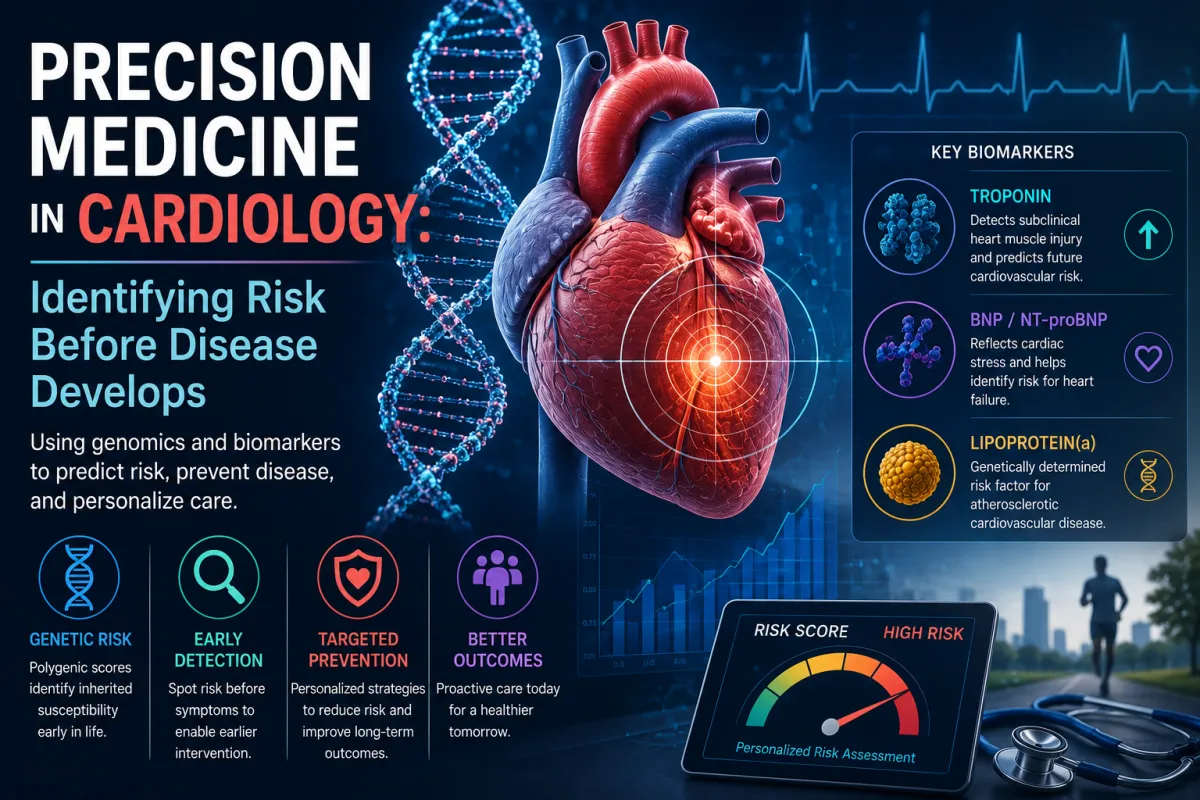
Precision Medicine in Cardiology: Identifying Risk Before Disease Develops
Introduction
Cardiovascular disease (CVD) remains the leading cause of mortality worldwide and continues to place a substantial burden on healthcare systems. Despite major advances in treatment and prevention, millions of individuals experience myocardial infarction, stroke, or heart failure each year. Traditional cardiovascular risk assessment models such as the Framingham Risk Score or pooled cohort equations rely primarily on demographic and clinical variables including age, blood pressure, cholesterol levels, smoking status, and diabetes.
While these tools have significantly improved population-level prevention strategies, they remain imperfect predictors of individual risk. Many cardiovascular events occur in individuals classified as having intermediate or even low predicted risk by traditional models. This limitation has led to increasing interest in precision medicine approaches that incorporate genetic, molecular, and biomarker data to improve individualized risk stratification.
Precision cardiology seeks to identify individuals at elevated risk long before clinical disease manifests. Advances in genomics, biomarker discovery, and data integration are enabling clinicians to move from reactive treatment toward proactive prevention. By identifying genetic predisposition and early biological signals of disease, healthcare systems may intervene earlier with targeted lifestyle, pharmacologic, or monitoring strategies.
Genetic Risk in Cardiovascular Disease
Polygenic Risk Scores
Many cardiovascular conditions including coronary artery disease (CAD), atrial fibrillation, and hypertension are complex traits influenced by numerous genetic variants rather than a single gene mutation. Genome-wide association studies (GWAS) have identified hundreds of variants associated with cardiovascular risk. Polygenic risk scores (PRS) integrate the cumulative effects of these variants into a single quantitative measure of inherited susceptibility. (OUP Academic)
The clinical relevance of PRS was highlighted in a landmark Nature Medicine study by Khera and colleagues, which analyzed data from hundreds of thousands of individuals in the UK Biobank. Investigators demonstrated that genome-wide polygenic scores could identify approximately 8% of the population with a greater than threefold increased risk of coronary artery disease comparable to the risk conferred by rare monogenic mutations such as familial hypercholesterolemia. (implementmd.org)
Importantly, polygenic risk is present from birth and therefore precedes the development of modifiable risk factors. This characteristic makes PRS particularly attractive as a tool for early risk stratification. Individuals identified as high genetic risk may benefit from earlier lipid screening, aggressive risk factor modification, and targeted preventive therapies.
However, several challenges remain before widespread clinical implementation. Polygenic scores often demonstrate reduced predictive accuracy in populations that were underrepresented in the original genetic studies. Furthermore, optimal strategies for integrating PRS into existing clinical risk models remain under investigation.
Familial Hypercholesterolemia
Familial hypercholesterolemia (FH) represents a well-characterized monogenic disorder that illustrates the impact of inherited cardiovascular risk. Mutations affecting genes involved in LDL cholesterol metabolism most commonly LDLR, APOB, or PCSK9 result in markedly elevated LDL cholesterol levels from early life and significantly increased risk of premature coronary artery disease.
Early identification of FH has important clinical implications. Untreated heterozygous FH can lead to coronary events decades earlier than in the general population. Yet the condition remains underdiagnosed worldwide. Precision medicine approaches such as cascade genetic screening testing relatives of affected individuals have been shown to improve detection and facilitate earlier treatment with lipid-lowering therapies.
The coexistence of monogenic and polygenic risk further complicates cardiovascular genetics. Some individuals without classical FH mutations may exhibit high LDL levels due to the cumulative effects of multiple common genetic variants. As genomic sequencing becomes more accessible, distinguishing between these mechanisms will become increasingly important for personalized risk assessment.
Biomarkers in Cardiology
While genetic information reflects lifelong predisposition, circulating biomarkers provide insight into current biological processes related to cardiovascular injury or stress. Several biomarkers have become central to clinical cardiology and may play expanding roles in precision risk prediction.
Cardiac Troponins
Cardiac troponins (troponin I and T) are structural proteins released into circulation following myocardial injury. High-sensitivity troponin assays have dramatically improved the detection of myocardial infarction and are now standard in acute care settings.
Beyond their diagnostic role in acute coronary syndromes, emerging evidence suggests that even low-level elevations in high-sensitivity troponin may reflect subclinical myocardial injury and predict future cardiovascular events. Studies have demonstrated associations between elevated troponin levels and increased risk of heart failure, coronary disease, and cardiovascular mortality in otherwise asymptomatic populations.
As assay sensitivity continues to improve, clinicians must interpret troponin results in clinical context. Chronic conditions such as renal disease, structural heart disease, or persistent myocardial stress may produce low-level elevations independent of acute ischemia.
B-type Natriuretic Peptide (BNP)
B-type natriuretic peptide and its inactive fragment, NT-proBNP, are released from ventricular myocardium in response to increased wall stress. BNP testing is widely used to diagnose and monitor heart failure.
In addition to its diagnostic utility, BNP may also serve as a predictive biomarker. Elevated BNP levels in asymptomatic individuals have been associated with an increased likelihood of developing heart failure or other cardiovascular events. (openheart.bmj.com)
Integration of BNP measurement into population screening strategies has been explored in several clinical trials. These studies suggest that biomarker-guided prevention programs may enable earlier detection of ventricular dysfunction and more targeted interventions.
Lipoprotein(a)
Lipoprotein(a), or Lp(a), is a genetically determined lipoprotein particle structurally similar to LDL but containing an additional apolipoprotein(a) component. Elevated Lp(a) concentrations are associated with increased risk of atherosclerotic cardiovascular disease and calcific aortic valve disease.
Unlike LDL cholesterol, Lp(a) levels are largely determined by genetics and remain relatively stable throughout life. Because lifestyle modification has limited influence on Lp(a), early measurement may identify individuals who would benefit from more aggressive management of modifiable risk factors.
Recent advances in RNA-targeting therapeutics are also renewing interest in Lp(a) screening. Several investigational agents designed to reduce Lp(a) synthesis are currently under evaluation in clinical trials.
Clinical Applications
Earlier Screening
One of the central goals of precision cardiology is to shift risk identification earlier in the disease trajectory. Genetic information can identify high-risk individuals decades before the development of clinical risk factors, enabling earlier screening and surveillance.
For example, individuals with elevated polygenic risk for coronary artery disease may benefit from earlier lipid testing or coronary artery calcium imaging. Similarly, detection of elevated Lp(a) or subtle biomarker abnormalities may prompt closer monitoring and preventive interventions.
Population-wide genomic screening programs are beginning to explore this approach. By identifying individuals with actionable genetic risk profiles, health systems may intervene before irreversible cardiovascular damage occurs.
Targeted Prevention Strategies
Precision medicine also enables more targeted preventive strategies. Traditional risk models treat populations with broadly similar approaches, whereas genomic and biomarker information can help stratify individuals according to their underlying biological risk.
For instance, individuals with high polygenic risk for coronary disease appear to derive particularly large relative benefit from statin therapy and lifestyle interventions in observational analyses. Such findings suggest that genetic information could eventually inform personalized thresholds for preventive pharmacotherapy.
Biomarkers may also guide prevention by identifying early physiological changes before symptoms appear. Elevated BNP levels or persistent low-level troponin elevations may indicate early myocardial stress, prompting interventions aimed at blood pressure control, metabolic optimization, or cardioprotective therapies.
However, implementing these approaches requires careful evaluation. Over-screening or overtreatment may expose patients to unnecessary costs and anxiety. Prospective trials are needed to determine the optimal use of genomic and biomarker data in routine practice.
Future Directions
Integrating Genomics with Lifestyle Medicine
The future of precision cardiology likely lies in integrating multiple layers of data including genomics, biomarkers, imaging, and lifestyle information into comprehensive risk models. Advances in computational biology and machine learning may enable clinicians to combine these data sources into more accurate predictive frameworks.
Importantly, genetic risk does not imply inevitability. Studies have demonstrated that favorable lifestyle behaviors including healthy diet, regular physical activity, and smoking avoidance can substantially reduce cardiovascular risk even among individuals with high genetic susceptibility.
Integrating genomic risk information into preventive cardiology therefore requires a balanced approach. Rather than deterministic interpretations of genetic findings, clinicians must emphasize modifiable risk factors and evidence-based interventions.
Implementation Challenges
Several challenges must be addressed before precision cardiology becomes routine clinical practice. These include:
Clinical validation: Large prospective studies are needed to demonstrate that genomic or biomarker-guided strategies improve clinical outcomes.
Population diversity: Many genetic studies have historically focused on individuals of European ancestry, limiting generalizability to diverse populations.
Data integration: Combining genomic, biomarker, and clinical data into actionable clinical tools requires robust informatics infrastructure.
Ethical considerations: Genetic testing raises questions related to privacy, informed consent, and potential insurance discrimination.
Addressing these issues will require collaboration among clinicians, geneticists, epidemiologists, policymakers, and health systems.
Conclusion
Precision medicine is reshaping the field of cardiology by enabling earlier identification of individuals at elevated risk for cardiovascular disease. Advances in genomic technologies, particularly polygenic risk scoring, provide new tools for understanding inherited susceptibility. At the same time, circulating biomarkers such as troponin, BNP, and lipoprotein(a) offer insights into early biological changes preceding clinical disease.
Together, these innovations support a transition from reactive treatment toward proactive prevention. By identifying risk before disease develops, clinicians may implement targeted screening, lifestyle interventions, and preventive therapies tailored to each patient’s biological profile.
Nevertheless, the integration of genomic and biomarker information into routine clinical practice remains an evolving process. Continued research, careful clinical validation, and thoughtful implementation will be essential to ensure that precision cardiology ultimately improves outcomes for patients worldwide.
References
Khera AV, et al. Genome-wide polygenic scores for common diseases identify individuals with risk equivalent to monogenic mutations. Nature Medicine. 2018.
JAMA Network. Polygenic risk scores for coronary heart disease. (JAMA Network)
European Heart Journal. Clinical utility of polygenic risk scores in cardiovascular disease. (OUP Academic)
Frontiers in Cardiovascular Medicine. Circulating biomarkers for cardiovascular disease risk prediction. (Frontiers)
BMJ Open Heart. Troponin and BNP as predictors of future cardiovascular disease. (openheart.bmj.com)
BMC Cardiovascular Disorders. BNP as a biomarker for heart failure risk. (Springer)
Scientific reviews on genomic risk in cardiovascular disease. (ScienceDirect)