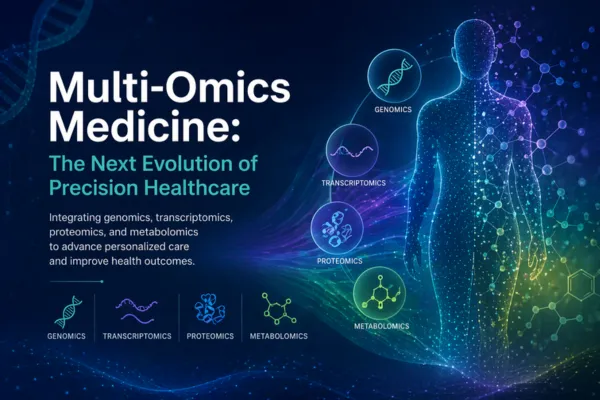
Multi-Omics Medicine: The Next Evolution of Precision Healthcare
Introduction
Precision medicine has increasingly transformed biomedical research and clinical practice by integrating molecular insights into disease diagnosis and treatment. Over the past two decades, advances in genomic sequencing technologies have provided clinicians and researchers with unprecedented access to the genetic underpinnings of human disease. These developments have contributed significantly to fields such as precision oncology, pharmacogenomics, and inherited disease diagnostics. However, while genomics has provided valuable insights into disease susceptibility and molecular mechanisms, genomic information alone cannot fully capture the complexity of biological systems.
Many diseases arise from dynamic interactions among multiple molecular layers within cells and tissues. Genetic variants may influence gene expression, protein function, metabolic pathways, and cellular signaling networks in ways that cannot be understood solely by examining DNA sequences. Consequently, the interpretation of genomic data in isolation may provide an incomplete picture of disease biology.
To address these limitations, researchers have increasingly adopted multi-omics approaches, which integrate data from multiple molecular domains including genomics, transcriptomics, proteomics, and metabolomics to provide a more comprehensive understanding of biological processes. Multi-omics medicine aims to capture the full spectrum of molecular activity within biological systems, enabling a systems-level perspective on disease mechanisms.
This emerging framework has the potential to reshape precision healthcare by improving disease classification, identifying novel therapeutic targets, and supporting earlier diagnosis and more individualized treatment strategies. As highlighted in recent reviews, multi-omics integration is becoming an increasingly important tool for advancing personalized medicine and understanding complex disease pathways (Hasin et al., 2017; Karczewski & Snyder, 2018).
What Multi-Omics Means
Multi-omics refers to the combined analysis of multiple layers of biological information derived from high-throughput molecular technologies. Each “omics” discipline captures a distinct dimension of cellular activity, providing complementary insights into biological function.
Genomics
Genomics focuses on the study of an organism’s complete DNA sequence, including genes and regulatory elements. Advances in next-generation sequencing have made it possible to analyze the human genome rapidly and at decreasing cost. Genomic data can reveal inherited variants associated with disease susceptibility as well as somatic mutations that contribute to cancer and other acquired disorders.
In clinical practice, genomic testing is widely used in oncology to identify actionable mutations and guide targeted therapy selection. It is also used in diagnosing rare genetic diseases and assessing hereditary disease risk.
Despite its importance, genomic information provides only a static representation of biological potential. It does not fully capture how genes are expressed or how molecular pathways function in real time.
Transcriptomics
Transcriptomics examines RNA molecules produced from gene transcription. By measuring gene expression levels across tissues or cell populations, transcriptomic analyses reveal which genes are actively expressed under specific conditions.
Techniques such as RNA sequencing (RNA-seq) allow researchers to quantify gene expression patterns and identify regulatory changes associated with disease. Transcriptomic studies have helped identify molecular subtypes of cancers and inflammatory diseases, providing insights into disease heterogeneity.
Because gene expression can change in response to environmental factors, cellular stress, and disease progression, transcriptomics provides a dynamic view of biological processes that complements genomic data.
Proteomics
Proteomics focuses on the large-scale study of proteins, which represent the functional molecules responsible for most cellular activities. Proteins regulate signaling pathways, enzymatic reactions, immune responses, and structural integrity within cells.
Proteomic technologies, including mass spectrometry-based approaches, allow researchers to measure protein abundance, post-translational modifications, and protein–protein interactions. These measurements can reveal alterations in signaling pathways that may contribute to disease.
For example, abnormal protein signaling has been implicated in many cancers and neurodegenerative disorders. Proteomic data can therefore provide insights into disease mechanisms that cannot be detected through genomic or transcriptomic analyses alone.
Metabolomics
Metabolomics examines small molecules and metabolites produced during cellular metabolism. These metabolites reflect the biochemical activity occurring within cells and tissues at a given moment.
Changes in metabolic pathways are often associated with disease states. For instance, alterations in glucose metabolism are a hallmark of many cancers and metabolic disorders. Metabolomic analyses can therefore reveal functional consequences of genomic and proteomic alterations.
By measuring metabolites in biological samples such as blood, urine, or tissue, metabolomics provides a snapshot of cellular physiology and can help identify biomarkers for disease detection and treatment monitoring.
Why Integration Matters
Understanding Complex Disease Pathways
Many human diseases including cancer, cardiovascular disease, autoimmune disorders, and neurodegenerative conditions arise from complex interactions among multiple molecular systems. A single genomic mutation may trigger downstream effects that influence gene expression, protein signaling networks, and metabolic processes.
Analyzing only one layer of biological information may therefore fail to capture the full scope of disease mechanisms. Multi-omics integration enables researchers to connect these different molecular layers, revealing how genomic alterations propagate through cellular networks.
For example, a genomic mutation may lead to altered gene expression, which subsequently affects protein activity and metabolic pathways. By analyzing these interconnected processes simultaneously, multi-omics approaches provide a more comprehensive understanding of disease biology.
This systems-level perspective is consistent with the principles of systems biology, which seeks to understand how interactions among biological components give rise to complex physiological behaviors.
Improving Disease Classification
Traditional disease classifications often rely on clinical symptoms or anatomical features. However, molecular studies have revealed that diseases previously considered homogeneous may consist of multiple biologically distinct subtypes.
Multi-omics analyses have helped identify molecular subgroups within conditions such as breast cancer, asthma, and inflammatory bowel disease. These subgroups may differ in their underlying mechanisms, clinical outcomes, and responses to therapy.
By integrating genomic, transcriptomic, proteomic, and metabolic data, researchers can develop more precise disease classifications that better reflect underlying biology.
Clinical Potential of Multi-Omics Medicine
Early Disease Detection
One of the most promising applications of multi-omics medicine is early disease detection. Molecular changes associated with disease often occur before clinical symptoms become apparent. Multi-omics analyses may identify biomarkers that signal early pathological changes, enabling earlier intervention.
For example, integrated molecular profiling has been explored for detecting early-stage cancers through circulating biomarkers. Combining genomic alterations with protein or metabolite signatures may improve diagnostic accuracy compared with single-marker approaches.
Similarly, multi-omics studies have identified molecular signatures associated with early neurodegenerative changes, suggesting potential applications in diseases such as Alzheimer’s disease.
Personalized Therapies
Multi-omics approaches also support the development of personalized treatment strategies. By integrating multiple layers of biological data, clinicians may be able to identify therapeutic targets more precisely and predict treatment responses more accurately.
In oncology, combining genomic and proteomic data can reveal activated signaling pathways that may be targeted with specific therapies. Multi-omics analyses may also help identify mechanisms of drug resistance and guide treatment adjustments.
In addition, metabolomic profiling may reveal metabolic vulnerabilities that could be targeted with specific pharmacologic interventions.
While these approaches remain largely in the research phase, they illustrate the potential of multi-omics medicine to refine therapeutic decision-making.
Implementation Challenges
Despite its promise, the implementation of multi-omics medicine presents several challenges.
One major challenge is data complexity. Multi-omics datasets are large and highly complex, requiring advanced computational tools for analysis and interpretation. Integrating multiple data types while maintaining accuracy and reproducibility remains a significant technical challenge.
Another issue involves clinical translation. Although many multi-omics studies have identified potential biomarkers or therapeutic targets, translating these findings into clinically validated tests requires rigorous evaluation through clinical trials and regulatory review.
Cost and infrastructure requirements also present barriers. Multi-omics analyses often require specialized laboratory technologies, high-performance computing resources, and multidisciplinary expertise. These requirements may limit accessibility in some healthcare settings.
Addressing these challenges will require collaboration among clinicians, molecular biologists, bioinformaticians, and policymakers.
Future Outlook: Systems Biology Approaches
The continued evolution of multi-omics medicine is closely linked to advances in systems biology, which aims to integrate diverse biological data into comprehensive models of human health and disease.
Emerging technologies such as single-cell sequencing, spatial transcriptomics, and advanced imaging methods are expanding the scope of molecular data available for analysis. These technologies allow researchers to examine biological processes at increasingly high resolution.
Artificial intelligence and machine learning algorithms are also playing an increasingly important role in analyzing complex multi-omics datasets. These computational tools can identify patterns and relationships within large datasets that may not be apparent through traditional analytical methods.
In the future, systems-level models that integrate genomic, molecular, environmental, and clinical data may provide new insights into disease mechanisms and treatment strategies. Such approaches could support predictive models of disease progression and treatment response, potentially improving clinical decision-making.
Conclusion
Multi-omics medicine represents an important step in the evolution of precision healthcare. While genomic technologies have significantly advanced our understanding of disease biology, the integration of multiple molecular layers offers a more comprehensive perspective on complex biological systems.
By combining genomics, transcriptomics, proteomics, and metabolomics, multi-omics approaches provide insights into the dynamic interactions that drive disease processes. These approaches have the potential to improve disease classification, support early diagnosis, and guide personalized treatment strategies.
However, significant challenges remain, including the integration and interpretation of complex datasets, the validation of multi-omics biomarkers, and the development of infrastructure needed to support large-scale molecular analyses.
Continued collaboration between clinical researchers, computational scientists, and healthcare systems will be essential for translating multi-omics discoveries into practical applications. As these technologies mature, multi-omics medicine is likely to play an increasingly important role in shaping the future of precision healthcare.
References
Hasin, Y., Seldin, M., & Lusis, A. (2017). Multi-omics approaches to disease. Genome Biology, 18(1), 83.
Karczewski, K. J., & Snyder, M. P. (2018). Integrative omics for health and disease. Nature Reviews Genetics, 19(5), 299–310.
Subramanian, I., et al. (2020). Multi-omics data integration, interpretation, and its application. Bioinformatics and Biology Insights.
Hasin, Y., et al. Multi-omics integration in biomedical research. Nature Reviews Genetics.
https://www.nature.com/articles/s41576-019-0153-3