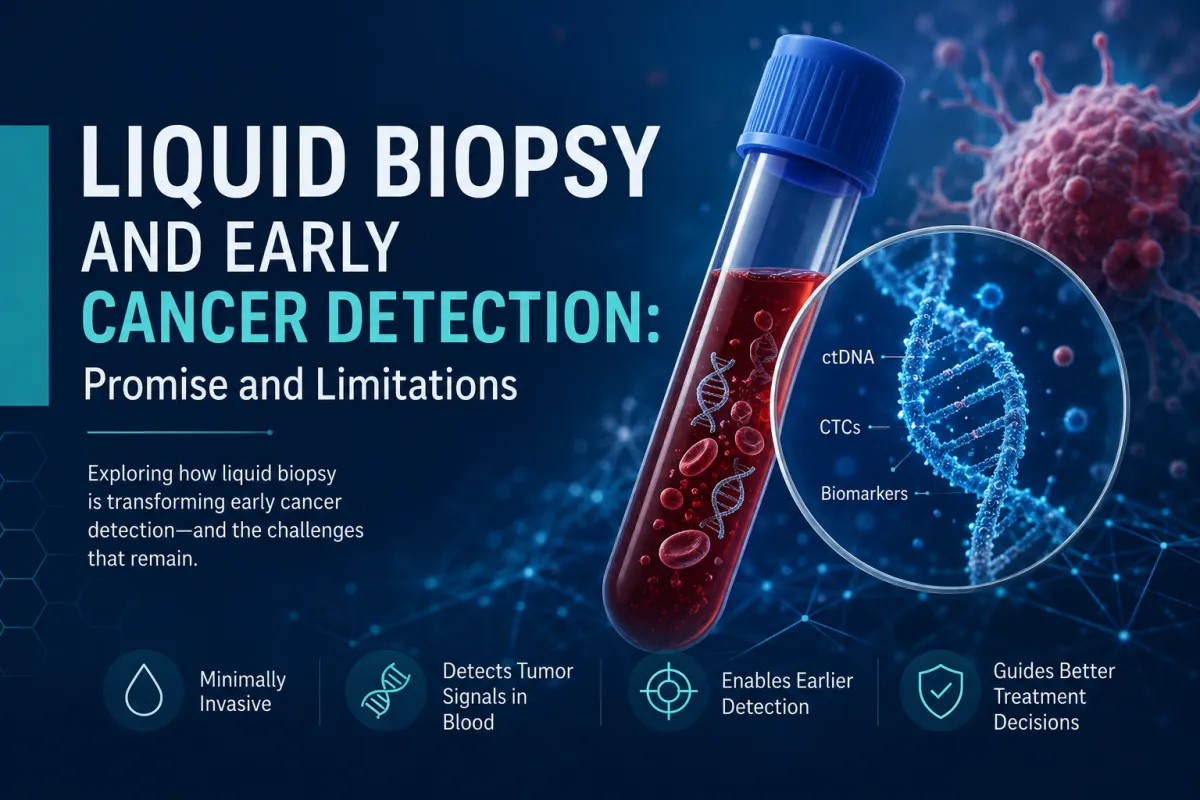
Liquid Biopsy and Early Cancer Detection: Promise and Limitations
Introduction
Early detection remains one of the most effective strategies for improving cancer outcomes. For many malignancies, prognosis is strongly associated with the stage at diagnosis, with survival rates significantly higher when tumors are detected before metastasis. Conventional diagnostic approaches including imaging, endoscopy, and tissue biopsy have played a critical role in cancer detection and management. However, these methods also have limitations, including invasiveness, sampling bias, and challenges in capturing the dynamic evolution of tumors.
In recent years, liquid biopsy has emerged as a promising tool in precision oncology. Liquid biopsy refers to the analysis of tumor-derived biomarkers present in body fluids most commonly blood to detect and monitor cancer. Unlike traditional tissue biopsy, which requires direct sampling of tumor tissue, liquid biopsy analyzes circulating molecular signals released by tumors into the bloodstream.
These signals include circulating tumor DNA (ctDNA), circulating tumor cells (CTCs), extracellular vesicles, and other biomolecules that reflect tumor biology. Advances in sequencing technologies and molecular diagnostics have enabled increasingly sensitive detection of these biomarkers, opening new possibilities for early cancer detection and real-time disease monitoring.
Despite these advances, liquid biopsy technologies also face important technical and clinical challenges, particularly in detecting early-stage disease and establishing validated applications across diverse cancer types. Understanding both the potential and the limitations of liquid biopsy is essential for clinicians, researchers, and healthcare leaders seeking to integrate emerging genomic tools into clinical practice.
How Liquid Biopsies Work
Liquid biopsy technologies rely on the detection and analysis of tumor-derived material circulating in the bloodstream or other body fluids. Tumor cells continuously release molecular fragments into circulation through processes such as apoptosis, necrosis, and active secretion. These fragments can be detected using sensitive molecular assays.
Two of the most widely studied components of liquid biopsy are circulating tumor DNA (ctDNA) and circulating tumor cells (CTCs).
Circulating Tumor DNA (ctDNA)
Circulating tumor DNA refers to fragments of tumor-derived DNA that are released into the bloodstream. ctDNA represents a subset of cell-free DNA (cfDNA) originating from cancer cells and carries tumor-specific genetic alterations such as point mutations, copy number variations, and methylation patterns.
Modern sequencing technologies including next-generation sequencing (NGS), digital PCR, and targeted mutation analysis enable the detection of these tumor-specific alterations at very low concentrations. These assays can identify genetic signatures associated with particular cancer types and track changes in tumor burden over time.
Because ctDNA reflects the molecular characteristics of tumor cells, it can provide insights into tumor heterogeneity and emerging resistance mutations. In clinical research, ctDNA analysis has demonstrated utility in monitoring treatment response, detecting minimal residual disease, and identifying early relapse following therapy.
However, the abundance of ctDNA in blood varies substantially depending on tumor type, stage, and biological factors. Early-stage tumors may release only minimal amounts of ctDNA, presenting a major challenge for detection.
Circulating Tumor Cells (CTCs)
Circulating tumor cells are intact cancer cells that detach from primary or metastatic tumors and enter the bloodstream. These cells can potentially seed new metastatic sites, making them clinically relevant biomarkers of disease progression.
CTCs can be isolated and analyzed using specialized platforms that capture tumor cells based on surface markers, size, or physical properties. Once isolated, these cells can be characterized using genomic, transcriptomic, or proteomic methods.
Research has demonstrated that higher CTC counts are often associated with poorer clinical outcomes in several cancer types, including breast, prostate, and colorectal cancer. Changes in CTC counts during therapy may also provide information about treatment response and disease progression.
While CTC analysis provides valuable biological insights, detecting these cells can be technically challenging because they occur at extremely low frequencies in circulation.
Clinical Applications of Liquid Biopsy
Liquid biopsy technologies are being investigated across multiple areas of oncology, ranging from early detection to treatment monitoring. Although many applications remain under active research, several clinical use cases are beginning to emerge.
Early Cancer Detection
One of the most ambitious goals of liquid biopsy research is the development of blood-based tests capable of detecting cancer before symptoms appear. These tests aim to identify tumor-derived DNA or other biomarkers that signal the presence of early-stage disease.
Studies have shown that tumors shed cell-free DNA into the bloodstream before clinical signs or symptoms develop, creating a potential window for preclinical detection.
Emerging technologies are exploring multi-cancer early detection (MCED) tests that analyze ctDNA patterns, including mutation profiles and epigenetic signatures, to detect multiple cancer types from a single blood sample. Machine learning approaches are increasingly being used to distinguish cancer-related signals from background biological noise.
Although these technologies show promise, clinical validation is ongoing, and sensitivity varies significantly across cancer types and stages.
Monitoring Treatment Response
Liquid biopsy has demonstrated particular value in monitoring therapeutic response. By analyzing ctDNA levels over time, clinicians can observe changes in tumor burden during treatment.
Decreases in ctDNA concentration may indicate effective therapy, while rising levels may signal treatment resistance or disease progression. Because ctDNA can be measured through serial blood sampling, this approach allows for continuous monitoring without repeated invasive procedures.
In some studies, changes in ctDNA levels have been detected weeks or months before radiographic evidence of disease progression becomes apparent. This ability to provide early signals of treatment response has important implications for personalized therapy and clinical trial design.
Detecting Recurrence and Minimal Residual Disease
Another emerging application of liquid biopsy is the detection of minimal residual disease (MRD) following curative-intent therapy.
After surgical removal of a tumor, small numbers of residual cancer cells may remain undetectable using conventional imaging. ctDNA assays can identify molecular evidence of residual disease by detecting tumor-specific mutations in the bloodstream.
Tumor-informed MRD assays are designed using the genetic profile of an individual patient’s tumor. These assays track specific mutations known to be present in the tumor and monitor their presence in blood samples over time. Detecting ctDNA after treatment may indicate a high risk of recurrence and could guide decisions regarding adjuvant therapy.
Advantages of Liquid Biopsy
Liquid biopsy offers several potential advantages compared with traditional tissue biopsy and imaging-based monitoring.
Non-Invasive Testing
Traditional tissue biopsy requires the surgical removal of tumor samples, which may be associated with discomfort, procedural risks, and logistical challenges. In some cases, tumors may be located in areas that are difficult to access safely.
Liquid biopsy requires only a blood sample or other body fluid, making it minimally invasive and easier to repeat over time. This feature is particularly valuable for longitudinal monitoring of disease progression and treatment response.
In addition, liquid biopsy can potentially capture molecular information from multiple tumor sites simultaneously, addressing the issue of tumor heterogeneity that may not be fully represented in a single tissue sample.
Real-Time Monitoring of Tumor Dynamics
Another advantage of liquid biopsy is its ability to provide real-time insights into tumor evolution.
Tumors continuously accumulate genetic changes as they grow and respond to therapy. Liquid biopsy allows clinicians to track these changes over time through serial blood sampling.
This capability may enable earlier detection of resistance mutations and allow clinicians to adapt treatment strategies more rapidly. The ability to monitor tumor dynamics in near real time represents a significant step toward more adaptive and personalized cancer care.
Current Limitations
Despite its potential, liquid biopsy remains an evolving technology with several important limitations.
Sensitivity for Early-Stage Disease
One of the most significant challenges is the limited sensitivity of liquid biopsy for early-stage cancer detection.
Early-stage tumors often shed very small amounts of DNA into the bloodstream, making ctDNA difficult to detect with current technologies. The amount of ctDNA typically increases as tumors grow and metastasize, meaning that detection rates are often higher in advanced disease.
Developing assays capable of detecting extremely low levels of ctDNA remains a major focus of ongoing research. Advances in sequencing depth, error correction techniques, and biomarker discovery may improve sensitivity in the future.
Validation Across Cancer Types
Another key challenge is the heterogeneity of cancer biology.
Different cancers vary widely in their rates of ctDNA shedding, molecular profiles, and detectability in blood-based assays. As a result, liquid biopsy tests may perform well for some cancer types while showing lower sensitivity for others.
Large-scale prospective clinical trials are needed to validate liquid biopsy technologies across multiple cancer types and clinical settings. These studies must evaluate not only analytical performance but also clinical outcomes, including whether early detection improves survival.
Furthermore, integrating liquid biopsy into clinical workflows requires careful consideration of false positives, cost-effectiveness, and health system infrastructure.
Future Research Directions
Continued research is likely to focus on several areas aimed at improving the clinical utility of liquid biopsy.
First, advances in ultra-sensitive sequencing technologies may enable detection of extremely low levels of ctDNA, improving early cancer detection.
Second, integrating multiple biomarkers including ctDNA mutations, methylation signatures, extracellular vesicles, and protein markers may enhance diagnostic accuracy.
Third, artificial intelligence and machine learning approaches are increasingly being used to analyze complex genomic patterns in liquid biopsy data, potentially improving the detection of cancer-specific signals.
Finally, large prospective studies will be essential to determine how liquid biopsy technologies can be integrated into screening programs, treatment monitoring strategies, and clinical decision-making pathways.
Conclusion
Liquid biopsy represents a rapidly advancing field within precision oncology, offering the potential to detect and monitor cancer through minimally invasive molecular testing. By analyzing circulating biomarkers such as ctDNA and circulating tumor cells, liquid biopsy provides new opportunities for early detection, treatment monitoring, and recurrence surveillance.
The ability to monitor tumor dynamics through simple blood tests could significantly enhance the practice of personalized medicine. However, important technical and clinical challenges remain particularly the limited sensitivity of current assays for early-stage disease and the need for robust validation across cancer types.
As research continues to refine liquid biopsy technologies and expand their clinical evidence base, these approaches may become increasingly integrated into cancer diagnostics and management. Achieving this goal will require collaborative efforts across academia, healthcare systems, and regulatory bodies to ensure that these emerging tools are both scientifically robust and clinically meaningful.
References
Wan JCM et al. Liquid biopsies come of age: towards implementation of circulating tumour DNA. Nature Reviews Cancer.
Landon BV et al. Liquid biopsies across the cancer care continuum. Nature Medicine.
Klein EA et al. Blood-based tests for multicancer early detection. The Lancet.
Ge Q et al. Liquid biopsy: Comprehensive overview of circulating tumor DNA. Oncology Letters.
Easaw S et al. Circulating tumor DNA in early-stage cancer detection and monitoring. Frontiers in Oncology.