
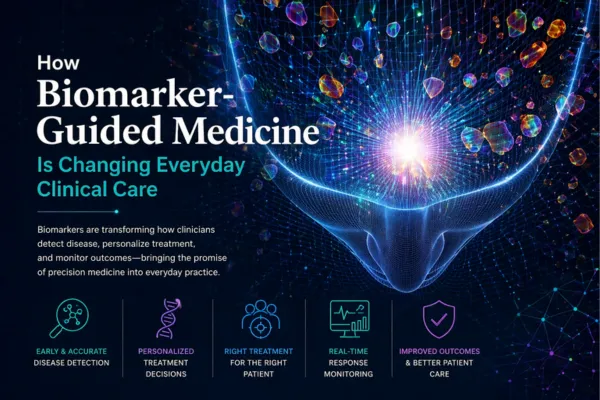
How Biomarker-Guided Medicine Is Changing Everyday Clinical Care
Introduction
Advances in biomedical research have significantly expanded the role of molecular and physiological indicators in clinical decision-making. Among the most influential of these developments is the increasing use of biomarkers to guide diagnosis, risk assessment, treatment selection, and disease monitoring. Biomarker-guided medicine represents a core component of precision medicine, emphasizing the use of measurable biological signals to inform individualized clinical care.
Historically, most medical treatments were developed and implemented based on average responses observed in large patient populations. Clinical trials typically evaluated therapies across heterogeneous groups, and treatment guidelines were subsequently applied broadly across patient populations with similar diagnoses. While this approach has contributed to major improvements in public health, it does not fully account for biological variability among individuals.
Patients with the same clinical diagnosis may differ substantially in underlying disease mechanisms, treatment responses, and long-term outcomes. These differences are increasingly recognized as being driven by genetic, molecular, environmental, and lifestyle factors. Biomarker-guided medicine seeks to address this variability by identifying measurable indicators that reflect disease biology and therapeutic response.
Across many medical specialties - including oncology, cardiology, immunology, and infectious disease - biomarkers are now used to support clinical decision-making. Their applications range from identifying patients at higher risk of disease progression to predicting responses to specific therapies. As highlighted in recent reviews, biomarkers have become central to modern diagnostic and therapeutic strategies across multiple areas of medicine (Strimbu & Tavel, 2010; Henry & Hayes, 2012).
This article examines the role of biomarkers in clinical medicine, focusing on their definitions, clinical applications, and implications for the future of healthcare.
What Is a Biomarker?
Defining Biomarkers in Clinical Medicine
A biomarker is broadly defined as a measurable biological characteristic that indicates normal biological processes, pathogenic processes, or responses to therapeutic interventions. Biomarkers may be detected in blood, tissue, imaging studies, or other biological samples and can include molecules such as proteins, nucleic acids, metabolites, or cellular markers.
The U.S. National Institutes of Health Biomarkers Definitions Working Group describes biomarkers as “characteristics that are objectively measured and evaluated as indicators of biological processes or pharmacologic responses to therapeutic intervention.” This definition highlights the role of biomarkers as measurable indicators of underlying biological activity.
Biomarkers may originate from various biological systems, including genomic alterations, protein expression patterns, metabolic pathways, or immune responses. Advances in high-throughput molecular technologies have greatly expanded the range of detectable biomarkers and their potential clinical applications.
Categories of Biomarkers
Biomarkers are commonly classified into three major categories based on their clinical function: diagnostic, prognostic, and predictive biomarkers.
Diagnostic biomarkers are used to detect or confirm the presence of a disease. These markers can support early diagnosis and improve the accuracy of clinical assessments. For example, elevated levels of cardiac troponin are widely used as a diagnostic biomarker for myocardial infarction.
Prognostic biomarkers provide information about the likely course or outcome of a disease independent of treatment. These markers may indicate the likelihood of disease progression, recurrence, or mortality. In oncology, tumor stage and certain molecular signatures can function as prognostic indicators.
Predictive biomarkers, by contrast, provide information about the likelihood that a patient will respond to a particular therapy. Predictive biomarkers are particularly important in precision medicine because they help identify patients who are most likely to benefit from targeted treatments.
In clinical practice, many biomarkers may serve multiple functions. For example, some biomarkers may provide both prognostic information and guidance for therapeutic decision-making.
Biomarkers Across Medical Specialties
The use of biomarkers is not limited to a single medical field. Instead, biomarkers have become increasingly integrated across multiple areas of clinical medicine.
In oncology, biomarkers such as HER2, EGFR, and PD-L1 are used to guide targeted therapy and immunotherapy decisions. In cardiology, biomarkers including troponin, B-type natriuretic peptide (BNP), and lipoprotein(a) provide information about cardiac injury and cardiovascular risk.
In autoimmune diseases, markers such as antinuclear antibodies (ANA) and anti-cyclic citrullinated peptide (anti-CCP) antibodies assist in diagnosing and monitoring conditions such as systemic lupus erythematosus and rheumatoid arthritis. Similarly, inflammatory biomarkers such as C-reactive protein (CRP) and erythrocyte sedimentation rate (ESR) are used across many specialties to evaluate systemic inflammation.
These examples illustrate how biomarkers can provide insights into diverse disease processes and support clinical decision-making across multiple disciplines.
How Biomarkers Change Clinical Decisions
Risk Stratification
One of the most important roles of biomarkers is risk stratification, the process of identifying patients who are at higher risk for developing disease or experiencing adverse outcomes. By identifying high-risk individuals, clinicians can tailor prevention strategies, initiate earlier interventions, or increase monitoring frequency.
For example, in cardiovascular medicine, elevated levels of lipoprotein(a) and certain inflammatory biomarkers have been associated with increased risk of coronary artery disease. These markers may help identify individuals who could benefit from more aggressive risk reduction strategies.
In oncology, genomic biomarkers can identify individuals with inherited cancer susceptibility syndromes, enabling earlier screening and preventive interventions.
Risk stratification using biomarkers therefore supports a more proactive approach to disease management.
Treatment Selection
Biomarkers also play an essential role in treatment selection, particularly in the context of targeted therapies. Predictive biomarkers help clinicians determine whether a patient is likely to respond to a specific treatment.
In oncology, testing for HER2 overexpression is used to identify patients who may benefit from HER2-targeted therapies in breast cancer. Similarly, EGFR mutations guide the use of EGFR inhibitors in non–small cell lung cancer.
Pharmacogenomic biomarkers represent another important category. Genetic variants affecting drug metabolism such as polymorphisms in the CYP2C19 or CYP2D6 genes can influence how patients respond to certain medications. Pharmacogenomic testing can therefore help clinicians select medications and dosages that are more appropriate for individual patients.
These examples demonstrate how biomarker-guided medicine can improve treatment precision and reduce the likelihood of ineffective therapies.
Monitoring Disease Progression
Biomarkers also provide valuable tools for monitoring disease progression and treatment response. Changes in biomarker levels over time can indicate whether a disease is improving, stabilizing, or worsening.
For example, in oncology, tumor markers such as prostate-specific antigen (PSA) may be used to monitor treatment response in prostate cancer. In cardiology, serial measurement of BNP levels can help assess the severity of heart failure and guide treatment adjustments.
Similarly, inflammatory markers such as CRP may be used to monitor disease activity in autoimmune conditions.
Because biomarkers can often be measured repeatedly through minimally invasive tests, they offer an important mechanism for ongoing disease monitoring.
Real-World Examples of Biomarker-Guided Care
Oncology Biomarkers
The field of oncology provides some of the most well-established examples of biomarker-guided medicine. Molecular profiling of tumors has revealed numerous genetic alterations that can be targeted with specific therapies.
Testing for HER2 amplification in breast cancer is one widely used example. Patients with HER2-positive tumors may benefit from HER2-targeted therapies, whereas patients without this biomarker are unlikely to respond to these treatments.
Similarly, PD-L1 expression can influence the use of immune checkpoint inhibitors in certain cancers. Although these biomarkers are not perfect predictors of response, they provide valuable information for clinical decision-making.
Cardiac Biomarkers
Cardiology has also benefited substantially from biomarker-driven diagnostics. Cardiac troponin is now considered the gold standard biomarker for diagnosing myocardial infarction. High-sensitivity troponin assays allow clinicians to detect cardiac injury earlier and with greater accuracy than older diagnostic methods.
Other biomarkers, such as BNP and NT-proBNP, are used to evaluate heart failure and guide treatment decisions. These markers help clinicians distinguish cardiac causes of dyspnea from other potential etiologies.
Inflammatory Markers
Inflammatory biomarkers such as CRP and interleukin-6 (IL-6) provide information about systemic inflammatory processes. These markers are used across multiple specialties, including rheumatology, infectious disease, and cardiovascular medicine.
Although these biomarkers are often nonspecific, they can help guide clinical evaluation and monitor treatment responses in various inflammatory conditions.
The Future of Biomarker-Driven Care
Integration with Genomics
The increasing availability of genomic technologies is expanding the range of biomarkers available for clinical use. Advances in sequencing technologies have enabled the identification of genomic alterations associated with disease susceptibility, therapeutic response, and treatment resistance.
In oncology, genomic biomarkers are increasingly used to guide targeted therapy selection. In other fields, such as cardiology and neurology, genomic research is beginning to identify risk-associated variants that may influence disease prevention strategies.
As genomic data becomes more widely integrated into healthcare systems, biomarker-guided medicine is expected to become increasingly common.
Artificial Intelligence and Data Integration
Another important development is the application of artificial intelligence (AI) to biomedical data. Machine learning algorithms can analyze complex datasets that include genomic, proteomic, imaging, and clinical information.
AI-based approaches may help identify new biomarkers, predict treatment responses, and integrate multiple data sources into clinically actionable insights. However, these technologies also raise challenges related to data quality, algorithm validation, and clinical implementation.
Ensuring that AI-driven biomarker tools are rigorously evaluated and appropriately regulated will be critical for their successful integration into clinical practice.
Conclusion
Biomarker-guided medicine is playing an increasingly important role in modern healthcare. By providing measurable indicators of disease processes and treatment responses, biomarkers help clinicians make more informed decisions about diagnosis, risk assessment, therapy selection, and disease monitoring.
Across specialties such as oncology, cardiology, and immunology, biomarkers are already shaping clinical practice. Advances in genomics, molecular diagnostics, and computational analysis are expected to further expand their clinical utility.
At the same time, challenges remain. These include ensuring the clinical validity of biomarkers, integrating complex data into healthcare systems, and addressing disparities in access to biomarker testing.
Continued research, multidisciplinary collaboration, and careful clinical evaluation will be essential for realizing the full potential of biomarker-guided medicine. As precision medicine continues to evolve, biomarkers are likely to remain central tools for improving the understanding and management of human disease.
References
Strimbu, K., & Tavel, J. A. (2010). What are biomarkers? Current Opinion in HIV and AIDS.
Henry, N. L., & Hayes, D. F. (2012). Cancer biomarkers. Molecular Oncology.
PubMed Central. Biomarkers in precision medicine.
https://www.ncbi.nlm.nih.gov/pmc/articles/PMC8074024/