
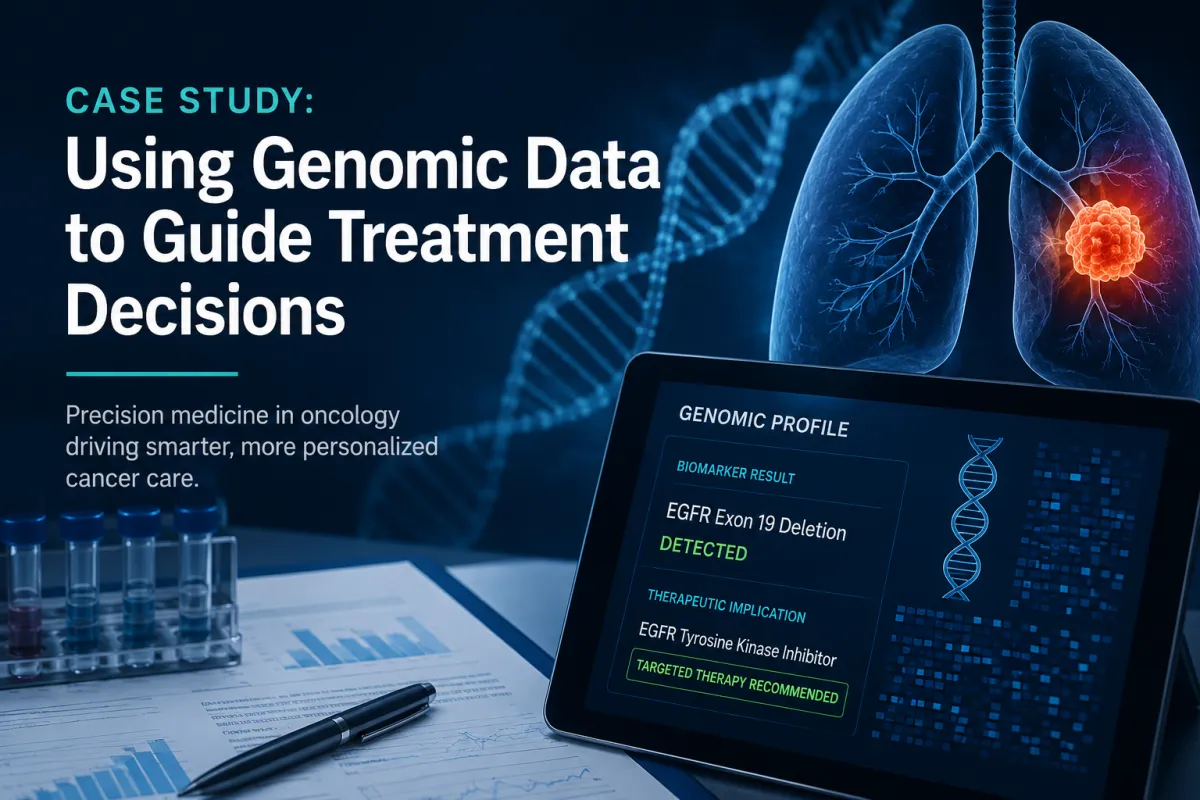
Case Study: Using Genomic Data to Guide Treatment Decisions
Introduction
The integration of genomic data into oncology has transformed how clinicians approach cancer diagnosis and treatment planning. Traditionally, cancer therapy decisions were largely guided by tumor histology, anatomical location, and stage of disease. While these parameters remain essential, advances in molecular diagnostics have revealed that cancers with similar histologic characteristics can harbor substantially different genomic alterations that influence disease behavior and treatment response.
Precision oncology seeks to address this complexity by tailoring therapy to the molecular features of a patient’s tumor. Through genomic sequencing technologies such as next-generation sequencing (NGS), clinicians can identify somatic mutations, gene fusions, copy number variations, and other alterations that may serve as predictive biomarkers for targeted therapies. This approach allows treatment selection to be informed not only by the type of cancer but also by the biological pathways driving tumor growth.
The clinical implementation of genomic profiling has expanded rapidly over the past decade. Multigene sequencing panels now routinely screen tumors for actionable alterations across hundreds of cancer-associated genes. These genomic insights have led to the development of targeted therapies designed to inhibit specific oncogenic pathways, enabling a more individualized approach to treatment selection.
This article presents a clinical case study illustrating how genomic data can inform treatment decisions in oncology. The case demonstrates how molecular profiling can identify actionable mutations, guide targeted therapy selection, and influence clinical outcomes. It also highlights broader lessons for clinical practice as precision medicine continues to evolve.
Patient Scenario
Clinical Presentation
A 56-year-old patient presented with a persistent cough, progressive dyspnea, and unexplained weight loss over a period of three months. The patient had a 20-pack-year smoking history but had quit smoking ten years prior. Physical examination revealed decreased breath sounds in the right lung field.
Computed tomography (CT) imaging identified a 3.5 cm mass in the right upper lobe of the lung with associated mediastinal lymphadenopathy. A subsequent biopsy confirmed the diagnosis of non–small cell lung cancer (NSCLC), specifically adenocarcinoma. Staging studies demonstrated regional lymph node involvement but no evidence of distant metastases.
Given the increasing role of molecular profiling in lung cancer management, the oncology team recommended comprehensive genomic testing to identify potential actionable alterations.
Testing Performed
Tumor tissue obtained during the biopsy was subjected to next-generation sequencing using a multigene cancer panel. These panels are designed to detect a broad range of genomic alterations, including point mutations, insertions and deletions, copy number changes, and gene fusions.
In addition to DNA sequencing, immunohistochemistry (IHC) was performed to evaluate protein expression of several biomarkers commonly used in lung cancer treatment planning.
Molecular testing in NSCLC has become standard practice in many clinical guidelines because a substantial proportion of tumors harbor targetable genomic alterations. Identifying these alterations can guide therapy selection and improve clinical outcomes by matching patients with therapies likely to be effective based on tumor biology.
Genomic Findings
Mutation Identified
Genomic analysis revealed a somatic mutation in the epidermal growth factor receptor (EGFR) gene, specifically an exon 19 deletion. EGFR mutations are among the most well-characterized driver alterations in NSCLC and are found in a subset of lung adenocarcinomas.
EGFR encodes a receptor tyrosine kinase involved in cellular signaling pathways that regulate cell proliferation, survival, and differentiation. Activating mutations in EGFR result in continuous signaling through downstream pathways, promoting uncontrolled tumor growth.
The identification of this mutation indicated that the tumor was likely dependent on EGFR signaling for its proliferation and survival, making the EGFR pathway a potential therapeutic target.
Pathway Affected
The EGFR protein plays a key role in the RAS–RAF–MEK–ERK signaling pathway, which regulates cellular proliferation and survival. When EGFR is activated by its ligands under normal physiological conditions, it initiates a cascade of intracellular signaling events.
However, activating mutations in EGFR lead to constitutive activation of this signaling pathway, allowing tumor cells to proliferate independently of external growth signals.
Understanding the molecular pathway affected by the mutation is essential for selecting targeted therapies. Drugs designed to inhibit EGFR kinase activity can disrupt this aberrant signaling and suppress tumor growth.
The ability to link specific genomic alterations with therapeutic targets is a central principle of precision oncology and underpins the clinical value of genomic profiling.
Treatment Selection
Targeted Therapy Chosen
Based on the identification of an activating EGFR mutation, the oncology team recommended treatment with an EGFR tyrosine kinase inhibitor (TKI). Targeted EGFR inhibitors are designed to block the kinase activity of the mutated receptor, thereby interrupting downstream signaling pathways that promote tumor growth.
Several EGFR inhibitors are approved for the treatment of EGFR-mutant NSCLC, including first-, second-, and third-generation agents. Third-generation inhibitors have demonstrated improved central nervous system penetration and activity against certain resistance mutations.
The decision to initiate EGFR-targeted therapy rather than conventional chemotherapy was based on evidence demonstrating improved response rates and progression-free survival among patients with EGFR-mutant NSCLC treated with targeted therapy.
This case illustrates how genomic profiling can shift treatment strategies from broadly cytotoxic therapies to molecularly targeted agents that address the underlying biology of the tumor.
Clinical Outcome
The patient initiated targeted therapy with an EGFR inhibitor and underwent routine clinical monitoring, including imaging and molecular testing.
Within eight weeks of treatment initiation, repeat CT imaging demonstrated a significant reduction in tumor size, consistent with a partial response according to RECIST criteria. The patient also reported improvement in respiratory symptoms and overall quality of life.
Serial monitoring of circulating tumor DNA revealed a decline in EGFR-mutant allele frequency, suggesting a reduction in tumor burden.
After approximately 14 months of therapy, imaging studies indicated gradual disease progression. Repeat molecular testing identified the emergence of a secondary resistance mutation (EGFR T790M), a known mechanism of resistance to earlier-generation EGFR inhibitors.
Based on these findings, the treatment regimen was adjusted to include a next-generation EGFR inhibitor designed to target this resistance mutation.
This adaptive treatment strategy illustrates the dynamic nature of precision oncology, where genomic testing may be repeated over time to identify evolving tumor biology and guide subsequent treatment decisions.
Lessons for Clinical Practice
The clinical case described above highlights several key principles relevant to the practice of precision oncology.
1. Genomic Profiling Enables Targeted Therapy Selection
Comprehensive molecular profiling allows clinicians to identify actionable genomic alterations that can inform therapy selection. In cancers such as NSCLC, identifying driver mutations such as EGFR, ALK, or ROS1 can significantly alter the treatment strategy.
Precision oncology relies on the identification of these molecular biomarkers to match patients with therapies likely to be effective based on the genetic characteristics of their tumors.
2. Molecular Testing Should Be Integrated Early in Clinical Care
In many cancer types, genomic testing is now recommended at the time of diagnosis or shortly thereafter. Early identification of actionable mutations can ensure that patients receive appropriate targeted therapies without unnecessary delays.
Integrating genomic testing into standard diagnostic workflows requires coordination among pathologists, molecular laboratories, and oncology teams.
3. Tumor Evolution Requires Ongoing Molecular Monitoring
Cancer is a dynamic disease characterized by genomic evolution over time. Tumors may acquire additional mutations that confer resistance to targeted therapies.
For this reason, repeat molecular testing often through liquid biopsy or repeat tissue biopsy may be necessary to identify new therapeutic targets as the disease progresses.
4. Implementation Challenges Remain
Despite the promise of precision oncology, several barriers remain. These include:
Limited access to comprehensive genomic testing in some healthcare systems
Interpretation challenges associated with variants of uncertain significance
Cost considerations and reimbursement policies
The need for clinical decision support tools to interpret complex genomic data
Expanding clinician education and developing standardized frameworks for genomic interpretation will be critical for broader clinical adoption.
Future Directions in Precision Oncology
The field of precision oncology continues to evolve rapidly. Advances in sequencing technologies, bioinformatics, and data integration are expanding the ability to identify clinically actionable genomic alterations.
Future developments may include:
Multi-omics profiling, integrating genomic, transcriptomic, and proteomic data
AI-assisted genomic interpretation to support clinical decision-making
Tumor-agnostic therapies, where treatment is guided by molecular alterations rather than cancer type
Improved clinical trial designs, such as basket and umbrella trials that evaluate targeted therapies in molecularly defined patient populations
As these approaches mature, genomic data will likely play an increasingly central role in cancer treatment planning.
Conclusion
Genomic profiling has become a cornerstone of modern oncology, enabling clinicians to tailor treatment strategies based on the molecular characteristics of individual tumors. By identifying actionable genomic alterations, precision oncology allows therapies to be selected that directly target the biological mechanisms driving cancer growth.
The case study presented here illustrates how genomic data can inform treatment decisions, guide targeted therapy selection, and support adaptive treatment strategies as tumors evolve. At the same time, it highlights the importance of integrating molecular testing into clinical workflows and addressing ongoing implementation challenges.
As genomic technologies continue to advance and evidence supporting their clinical utility grows, precision oncology is expected to play an increasingly important role in improving outcomes for patients with cancer.
References
Malone ER et al. Precision Oncology: Current Approaches and Future Directions. Nature Reviews Clinical Oncology.
Garraway LA, Verweij J, Ballman KV. Precision oncology: an overview. J Clin Oncol.
Chakravarty D et al. OncoKB: Precision Oncology Knowledge Base. JCO Precision Oncology.
Dienstmann R et al. Genomic medicine frontier in oncology. Nature Reviews Clinical Oncology.
Malone ER et al. Precision oncology: Current landscape and future directions. CA: A Cancer Journal for Clinicians.