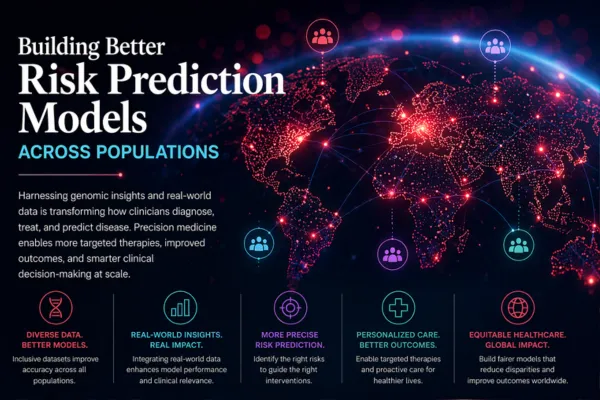
Building Better Risk Prediction Models Across Populations
Introduction
Risk prediction models play a central role in modern preventive medicine. These models estimate the probability that an individual will develop a specific disease over a defined time period, using combinations of demographic, clinical, behavioral, and increasingly, genetic variables. Such models are widely used in clinical decision-making, informing screening strategies, preventive interventions, and treatment planning. Examples include cardiovascular risk calculators, cancer screening eligibility models, and polygenic risk scores derived from genomic data.
However, the effectiveness of many current predictive models remains limited by issues related to population representation and model generalizability. Many widely used risk prediction tools were developed using datasets drawn from relatively homogeneous populations. As a result, these models may not perform equally well across different demographic groups, geographic regions, or ancestral populations.
Recent research has highlighted the importance of developing risk prediction models that account for diverse populations and complex biological variability. As genomic data becomes increasingly integrated into risk modeling, the need for inclusive datasets and robust analytical methods has become more apparent. Predictive models that do not adequately capture population diversity may produce inaccurate risk estimates, potentially contributing to disparities in prevention strategies and healthcare outcomes.
Improving the accuracy and equity of risk prediction models requires integrating diverse genomic datasets, leveraging advanced analytical methods such as machine learning, and validating models across heterogeneous populations. These approaches are becoming central to the development of next-generation predictive tools in precision medicine.
Limitations of Current Predictive Models
Historical Development of Risk Models
Many clinical risk prediction models were developed using traditional epidemiological approaches that relied on cohort studies conducted in specific geographic or demographic populations. For example, the Framingham Risk Score, widely used to estimate cardiovascular disease risk, was originally derived from a predominantly European-ancestry cohort in the United States.
Although these models have provided valuable guidance for clinical decision-making, their predictive performance may decline when applied to populations that differ substantially from the original study cohort. Differences in genetic background, environmental exposures, lifestyle factors, and healthcare access can all influence disease risk.
This limitation becomes even more pronounced as predictive models incorporate genomic information. Genome-wide association studies (GWAS) have identified thousands of genetic variants associated with complex diseases, enabling the development of polygenic risk scores (PRS) that estimate genetic predisposition to conditions such as cardiovascular disease, diabetes, and certain cancers.
However, most GWAS studies have historically been conducted in populations of European ancestry. Consequently, polygenic risk scores derived from these datasets often demonstrate reduced predictive accuracy when applied to individuals from other ancestral backgrounds.
Generalizability and Bias in Risk Prediction
When predictive models are trained using datasets that lack diversity, their performance may vary across populations. This phenomenon reflects differences in allele frequencies, linkage disequilibrium patterns, environmental exposures, and gene–environment interactions across populations.
For example, studies have shown that polygenic risk scores derived from European ancestry datasets can lose predictive accuracy when applied to individuals of African ancestry. In some cases, the reduction in predictive performance may be substantial.
These disparities highlight the need for predictive models that are validated across diverse populations and incorporate data reflecting global genetic variation. Without such efforts, precision medicine tools may inadvertently perpetuate existing healthcare disparities.
Improving Model Accuracy
Expanding Diverse Genomic Datasets
One of the most important strategies for improving risk prediction models is the expansion of diverse genomic datasets. Increasing representation from historically underrepresented populations can improve the accuracy of genetic association studies and enhance the reliability of polygenic risk scores.
Large-scale initiatives are underway to address this gap. International research programs are now focusing on recruiting participants from diverse populations and building genomic datasets that better represent global genetic diversity. These efforts include population-based sequencing initiatives, multi-ethnic biobanks, and collaborative genomic research networks.
Greater diversity in genomic datasets not only improves predictive accuracy but also enables the discovery of novel genetic variants associated with disease. Some variants may be rare or absent in certain populations but more common in others, highlighting the importance of inclusive research designs.
Additionally, integrating genomic data with environmental, clinical, and lifestyle information can help researchers better understand how genetic and non-genetic factors interact to influence disease risk.
Machine Learning and Advanced Analytical Methods
Advances in computational science have introduced new analytical methods that may improve risk prediction modeling. Machine learning algorithms, in particular, are increasingly used to analyze complex datasets that include genomic, clinical, and environmental variables.
Machine learning methods can identify nonlinear relationships and interactions among variables that may not be captured by traditional statistical models. For example, algorithms such as random forests, gradient boosting machines, and deep learning models have demonstrated potential in predicting disease risk from large, multidimensional datasets.
These approaches are particularly valuable when integrating multiple sources of biological data, including genomics, transcriptomics, proteomics, and electronic health records. By combining diverse data types, machine learning models can generate more nuanced predictions of disease risk.
However, the use of machine learning in healthcare also presents challenges. Model interpretability, data quality, and potential algorithmic bias must be carefully addressed. Ensuring that machine learning models are transparent and clinically interpretable remains an important priority for healthcare systems.
Clinical Applications of Improved Risk Prediction
Screening Programs
Accurate risk prediction models are critical for optimizing population screening programs. Screening guidelines often rely on risk thresholds to determine which individuals should undergo diagnostic testing or preventive interventions.
For example, risk models are used to guide screening for conditions such as breast cancer, colorectal cancer, and cardiovascular disease. Incorporating genomic information into these models may allow clinicians to identify individuals at higher risk who could benefit from earlier or more frequent screening.
Polygenic risk scores have been explored as potential tools for stratifying individuals based on genetic susceptibility to disease. In breast cancer, for instance, PRS models have been investigated as a way to personalize screening recommendations.
However, for these models to be clinically useful, they must perform reliably across diverse populations. This requirement underscores the importance of developing predictive tools that incorporate diverse datasets and undergo rigorous validation.
Preventive Medicine
Risk prediction models also play a central role in preventive medicine. Identifying individuals at increased risk for disease enables targeted preventive interventions such as lifestyle modifications, pharmacologic therapies, or enhanced clinical monitoring.
For example, cardiovascular risk models guide decisions regarding statin therapy and other preventive strategies. Similarly, genomic risk models may help identify individuals with elevated susceptibility to certain cancers or metabolic diseases.
As predictive models improve, clinicians may be able to tailor prevention strategies more precisely to individual patients. Integrating genetic and environmental risk factors may provide a more comprehensive understanding of disease risk than traditional models alone.
Implementation Challenges
While improved risk prediction models hold promise for enhancing precision medicine, several challenges remain in translating these models into clinical practice.
One key challenge is data integration. Risk prediction models increasingly rely on multiple data sources, including genomic information, electronic health records, and environmental exposure data. Integrating these diverse datasets in a standardized and secure manner requires robust data infrastructure.
Another challenge involves model validation and clinical utility. Predictive models must be rigorously tested across different populations and healthcare settings to ensure that they provide accurate and clinically meaningful information. Without proper validation, predictive tools may produce misleading risk estimates.
Ethical considerations are also important. Risk prediction models that incorporate genetic data raise questions about data privacy, informed consent, and equitable access to genomic testing. Healthcare systems must ensure that predictive technologies are implemented in ways that promote fairness and avoid exacerbating disparities.
Future Directions
Future research will likely focus on developing more inclusive and integrative risk prediction models that account for both genetic and environmental determinants of health. Advances in multi-omics technologies may enable researchers to incorporate additional biological layers—such as gene expression, protein activity, and metabolic pathways—into predictive frameworks.
Artificial intelligence and machine learning are also expected to play an expanding role in predictive modeling. As healthcare datasets grow in size and complexity, advanced computational tools will become increasingly important for identifying patterns that inform disease risk prediction.
Another important direction involves the development of dynamic risk prediction models that update risk estimates over time as new clinical or molecular data become available. Such models could enable more responsive and individualized preventive care strategies.
Ultimately, improving risk prediction models across populations will require sustained collaboration among clinicians, geneticists, data scientists, and public health researchers.
Conclusion
Risk prediction models are essential tools for guiding screening programs, preventive interventions, and clinical decision-making. However, many existing models were developed using datasets that do not adequately represent the diversity of global populations.
As precision medicine continues to evolve, improving the accuracy and equity of risk prediction models has become a key priority. Expanding diverse genomic datasets, applying advanced analytical methods such as machine learning, and validating models across heterogeneous populations are critical steps toward achieving this goal.
Better predictive models have the potential to improve disease prevention strategies and enable more personalized healthcare. Ensuring that these models perform effectively across diverse populations will be essential for realizing the promise of precision medicine.
References
Martin, A. R., et al. (2020). Clinical use of polygenic risk scores may exacerbate health disparities. Nature Genetics.
https://www.nature.com/articles/s41588-020-00735-5
Lewis, C. M., & Vassos, E. (2020). Polygenic risk scores: From research tools to clinical instruments. Genome Medicine.
Torkamani, A., Wineinger, N. E., & Topol, E. J. (2018). The personal and clinical utility of polygenic risk scores. Nature Reviews Genetics.
